
Saint Quentin
rue Henri Barbusse
62860 Écourt-Saint-Quentin
Church | 1865-1867 | Neogothic | Catholic Church


Map
Opening hours
01 January - 31 December
Mon 10.00 - 12.00 • 14.00 - 17.00
Tue 14.00 - 16.00
Wed 14.00 - 17.00
Thu 14.00 - 16.00
Fri 14.00 - 16.00
Sat 10.00 - 12.00
Sun
The church is open every second Sunday of the month during the market.
Religious offices
Description
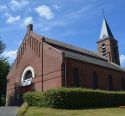
1867. The church is rebuilt in the neo-Gothic style under the direction of architect Charles Leroy, who was also responsible for Notre-Dame de la Treille in Lille.
1914-1918. The area is on the front lines of the conflict during the First World War. The village is occupied by the Germans and the church is converted into a hospital and then bombed. The municipality receives the Croix de Guerre in 1920 and probably joins the diocese's cooperative society for the reconstruction of its church.
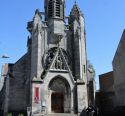
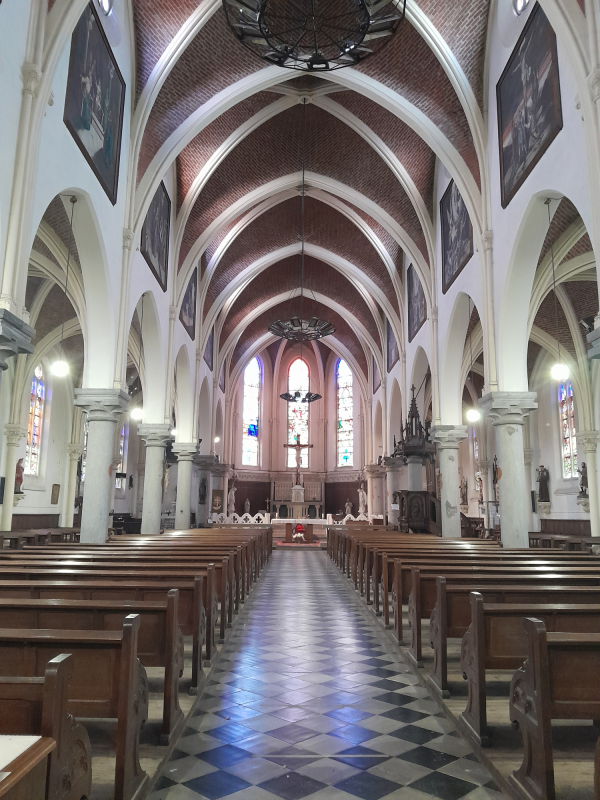
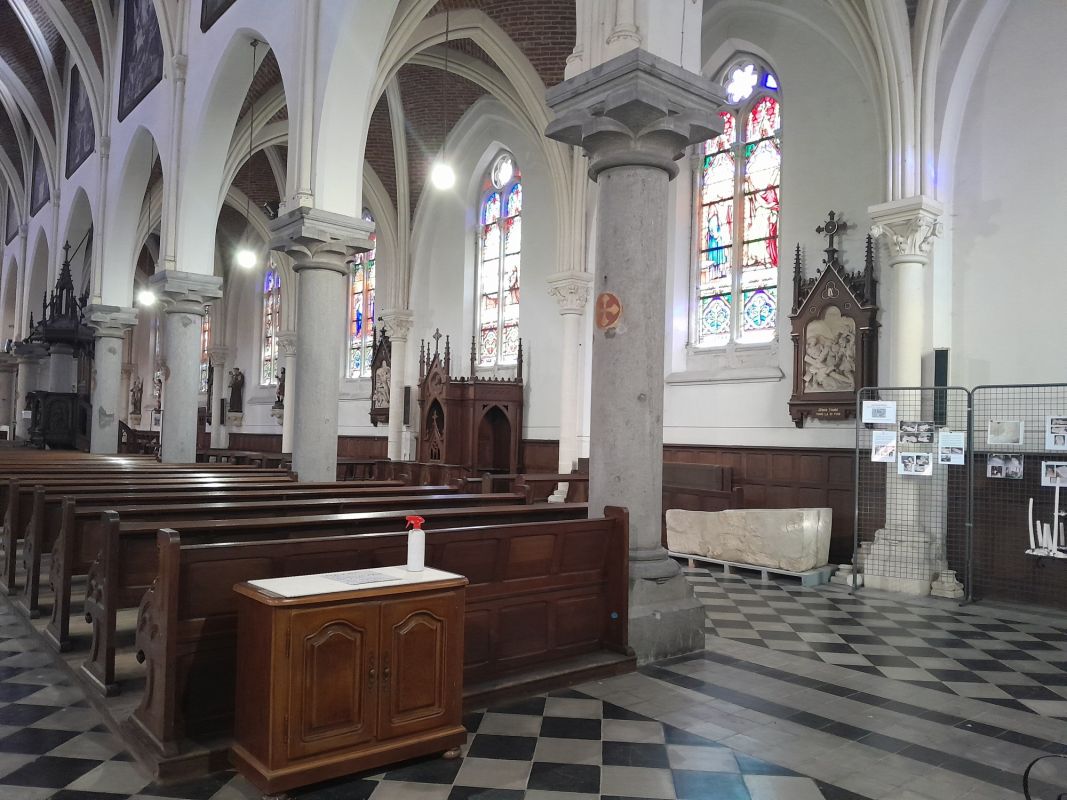
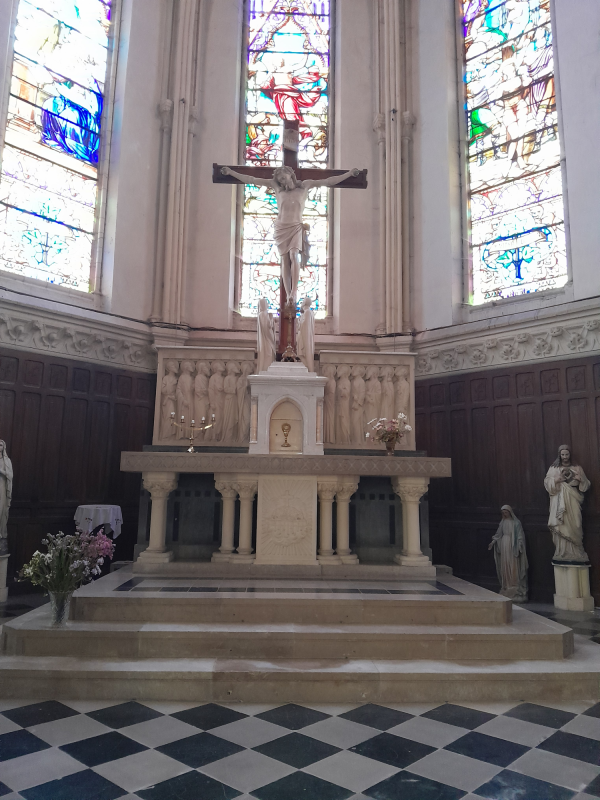
1922-1925. Architect Pierre Regnault (originally from Rennes) proposes a traditional reconstruction in neo-Gothic style. The entrance through the bell tower porch (48 metres high) opens onto a 50-metre nave, whose bays, separated by pointed arches, draw the eye towards the choir. The aisles are lit by large stained-glass windows by Jules Dreptin (Lille).
1974. The village is the site of an important archaeological discovery: graves are unearthed during earthworks. The items found in the two stone sarcophagi (funeral vases and weapons) date these tombs to the Merovingian period (6th-7th centuries). The use of this burial technique in the heart of this small village attests to the presence of a Frankish population of high social standing. The sarcophagi are now on display in the church.
2022. The municipality joins the Artois Heritage Villages network and offers hiking trails for exploring this area surrounded by marshes.
Translated with www.DeepL.com/Translator (free version)

Photos



Remarkable elements

Sculpted group depicting the martyrdom of Saint Quentin
Listed as a historic monument since 1959, this 17th-century oak sculpture depicts the martyrdom of Saint Quentin, as his executioners drive nails and spikes into his body.
According to tradition, Quentin was born in Rome in the 3rd century and travelled throughout Gaul, particularly in the north, to spread the Gospel. He was arrested by a Roman governor who had him imprisoned, tortured and then beheaded.
Translated with www.DeepL.com/Translator (free version)

Stained glass windows
Between 1928 and 1930, the parish priest commissioned a series of stained glass windows from glassmaker Jules Dreptin. The project was financed entirely by donors who chose to dedicate the windows to their patron saints. Two commemorative stained glass windows stand out for their depiction of soldiers being carried away by an angel. The same model for one of them is kept in the nearby church of Monchy-le-Preux.
Translated with www.DeepL.com/Translator (free version)
Statues of the Virgin and Child and Saint Anne
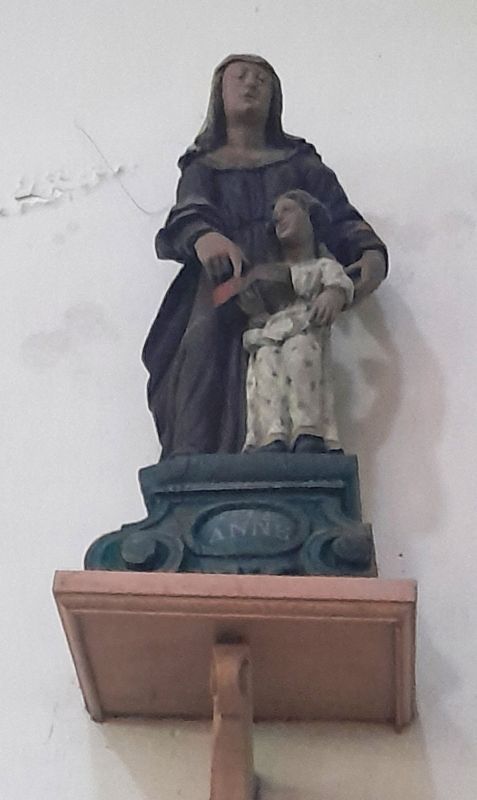
These two polychrome wooden statues depicting the Virgin and Child and Saint Anne teaching Mary come from the Sainte-Anne Chapel built in 1703 by Élie Duflos.
Translated with www.DeepL.com/Translator (free version)

Paintings in the nave
This series of 14 paintings depicting the mysteries of the Rosary (events related to the life of the Virgin Mary) was created by the Douai artist Jules Cellier. The episodes can be viewed from the left, starting from the choir (Annunciation) towards the porch, then the other side of the porch towards the choir (Assumption and Coronation of Mary).
Translated with www.DeepL.com/Translator (free version)

Confessionals
This neo-Gothic furniture has a distinctive feature. In a quatrefoil above the door is carved the portrait of John of Nepomuk, patron saint of priests (1340–1393). He places his finger on his mouth as if to signify the silence kept by priests during confession.
Translated with www.DeepL.com/Translator (free version)

Merovingian tombs
In 1974, around twenty graves were uncovered on the main road of the commune during earthworks. Among them were two stone sarcophagi and objects (vases and weapons) attesting to a Merovingian presence in the area, and probably of people of a certain social standing to be buried in such a tomb.
Translated with www.DeepL.com/Translator (free version)