Saint Martin
rue de la Mairie
62156 Dury
Church | 1923-1925 | Neoromanesque | Catholic Church

Map
Opening hours
01 July - 31 August
Mon
Tue
Wed
Thu
Fri
Sat 10.00 - 18.00
Sun
Description
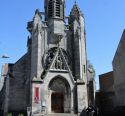
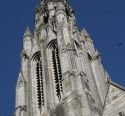
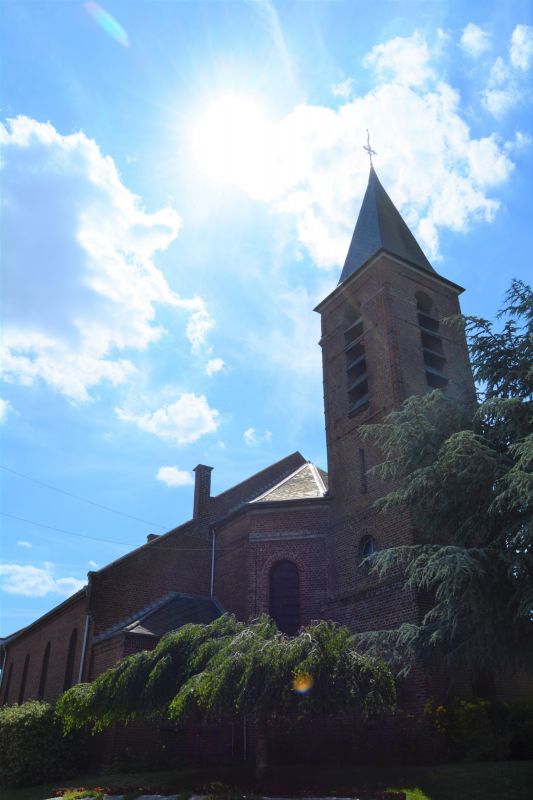
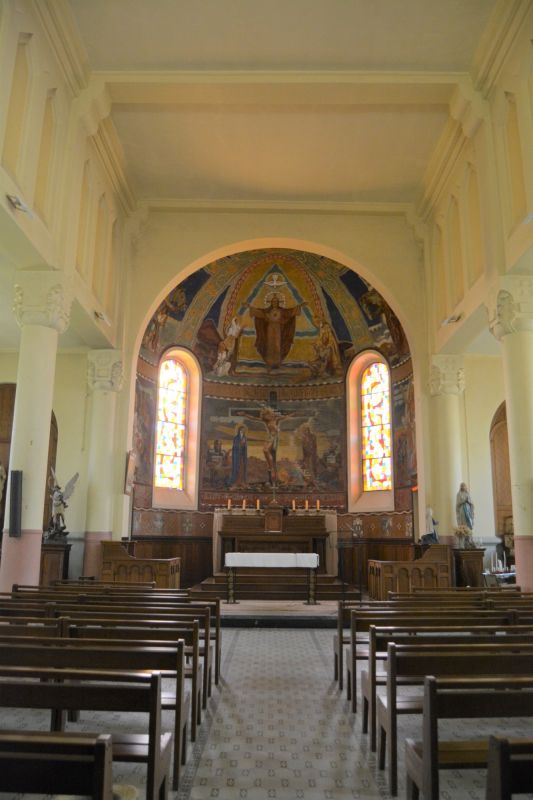
In 1920, the municipality joined the cooperative for the reconstruction of churches in the diocese of Arras, which chose the architect Honoré Pons. For the church in Dury, rebuilt between 1923 and 1925, he drew inspiration from Romanesque art and designed a nave flanked by aisles and ending in a rounded choir. He added a unique feature by placing the entrance opposite the bell tower. The stained glass windows were made in 1926 by the Compagnie des Vitraux d'Art de Bruxelles thanks to donations from the local population. As for the interior design, the artistic movement in vogue in the 1920s was Art Deco. The liturgical furniture is a perfect example of this: the high altar, stalls, confessional, etc.
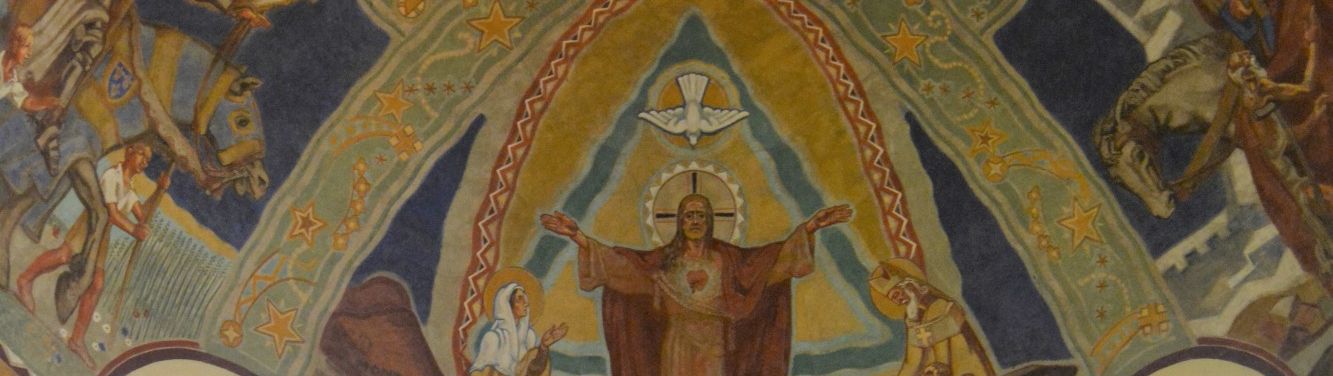
In the 1950s, after the Second World War, the artist Émile Flament found himself in Dury. He worked on a decorative fresco in the choir. The faces of the figures surrounding Christ curiously resemble those of the local inhabitants. In fact, the fresco was made possible thanks to exclusive funding from donors. To preserve this memory and thank them for their generous contribution, he wrote their names on a list which he sealed into the wall.
The church in Dury is not simply a story of reconstruction: it bears witness to the revival of this village, through a discreet gesture that is so precious for future generations.
Translated with DeepL.com (free version)


Photos

Remarkable elements

Baptismal font
A simple sandstone column forms the base on which a double copper basin rests. The ensemble probably dates from the 16th century and has been listed as a historic monument since 1986.
A fence has been installed using pieces from the old communion bench.
Translated with www.DeepL.com/Translator (free version)

Fresco by Émile Flament
Created in 1951–1952, this fresco depicts the Last Supper, the Crucifixion, the Resurrection and the Ascension. Its greatest secret was hidden behind the paint: a cartouche containing the list of donors, whose faces appear in the features of the characters surrounding Christ. This gesture by the artist recalls the commitment of a community united in the renewal of the village after the trials of two world wars.
Translated with www.DeepL.com/Translator (free version)

Art Deco furniture
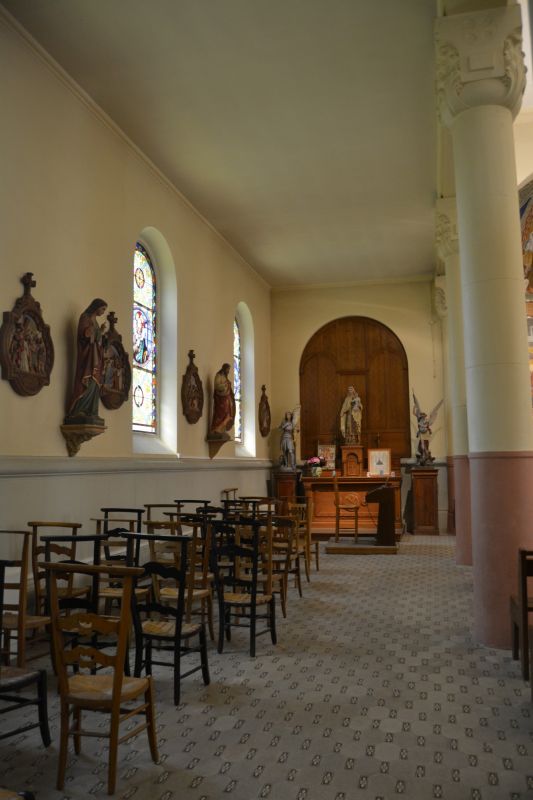
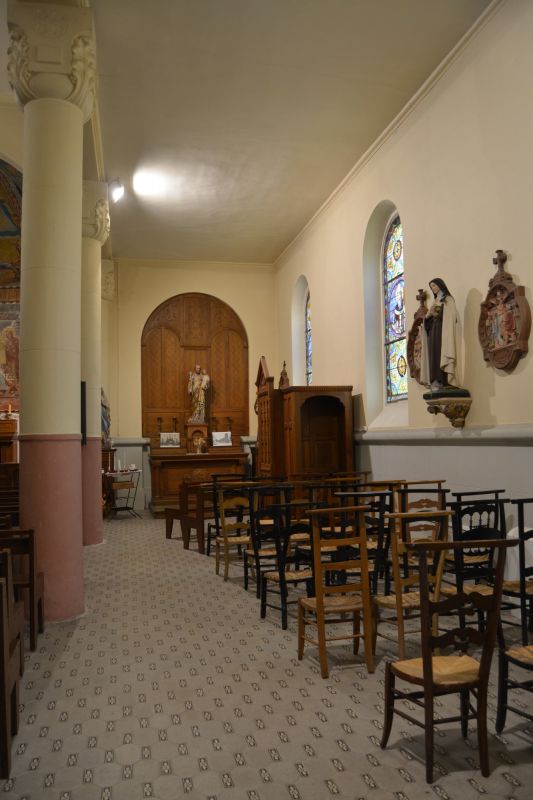
The interwar period saw a revival of sacred art, bringing contemporary art into churches through a new artistic movement: Art Deco. Liturgical furniture used the general codes of this style: geometric shapes and simplicity in decoration.
Thus, the stalls, the baptismal font enclosure, the pulpit and the altars are perfect examples of the development of this artistic style in the provinces.
Translated with www.DeepL.com/Translator (free version)

Stained glass windows and Stations of the Cross: a collective effort
The local community played a major role in decorating and furnishing the church in Dury. This collective effort began in the 1920s with the financing of stained glass windows and Stations of the Cross, which still bear the names of the donors on each frame.
Translated with www.DeepL.com/Translator (free version)

Siméon Lourdel
Born in Dury in 1853 into a devout peasant family, he quickly joined the Missionaries of Africa and was ordained a priest in 1877 in Algiers. Two years later, he arrived in Buganda (Uganda) with the first Catholic missionary caravan led by Léon Livinhac. Nicknamed ‘Mapéra’ (my Father), he contributed to the establishment of Catholicism in the region before dying in 1890 at the age of only 37.
Translated with www.DeepL.com/Translator (free version)

Village of yesteryear
Dury is a little natural paradise near the Sensée Valley. Designated a heritage village, the commune seems frozen in time with its brick buildings, square farm, large early 20th-century residences, old brewery and former electric flour mill. Then, at the bend in a street, or simply before entering the church, there is a reminder of the troubled past, a memory of the Great War.
To follow the Heritage Village trail, click here...
Translated with www.DeepL.com/Translator (free version)