Saint Martin
Grand Place
59310 Nomain
Church | XI-XII-XVII | Romanesque, Gothic, Classical | Catholic Church


Map
Opening hours
01 January - 31 December
Mon 9.00 - 18.00
Tue 9.00 - 18.00
Wed 9.00 - 18.00
Thu 9.00 - 18.00
Fri 9.00 - 18.00
Sat 9.00 - 18.00
Sun
Religious offices
Description
The church, originally built in a sober Romanesque style, was erected using materials salvaged from a Gallo-Roman villa discovered in the area, evidence of an earlier occupation of the site.
Nomain's bell tower, along with those of Aix-en-Pévèle and Flines-lez-Raches, is one of the oldest in the region. Its base dates from the 11th century and its square sandstone tower from the 13th century.
Over the centuries, the church has undergone a number of transformations. Gothic additions, including a chapel, enriched the building and changed its appearance. In the 17th century, the structure was redesigned in the typical style of the ‘hallekerque’, the large hall-churches typical of the region.
In the 19th century, the church underwent several extensions and restoration campaigns. Between 1842 and 1847, Douais architect François DISLERE gave it its current appearance. The roof was repaired between 1883 and 1889. The current spire was added in 1895.
In 2000, the church underwent another facelift, before its steeple in 2020.
Photos




Remarkable elements

The Baptism of Christ
Formerly located in the baptismal font chapel, this small oil painting on wooden panels dates from the 18th century and has been listed as a Historic Monument since 1973. The anonymous artist depicts the Baptism of Christ by his disciple John the Baptist. The figures are set against a backdrop of abundant, ethereal vegetation. In radiant glory, the Holy Spirit, represented by a dove, overhangs and illuminates the scene. The Baptist's cloak is in red, the only dominant colour in the painting.
Currently undergoing restoration, it is being sponsored by Allianz France as part of the ‘Le Plus Grand Musée de France 2024’ competition, run by the Sauvegarde de l'Art Français foundation.

Porch
The porch bell tower is the oldest part of the church, bearing witness to two major stages of construction:
- the 12th-century Romanesque base, whose exterior façade is adorned with three blind semi-circular arches. When the bell tower was added in the following century, the interior arcades redefined the original volume. The stonework is irregular and heterogeneous, having been reused from Gallo-Roman times.
- The 13th-century elevation is built of more regular stonework, with an embrasure and two semi-circular openings on each side. A cornice supported by modillions tops the whole.

Stained glass
Today's stained glass windows come from the former church of Notre-Dame de la Visitation in Auby, also in the Pévèle region. The church was threatened with collapse due to mining activity, and its stained glass windows were sold in the 1950s. Weakened by mining subsidence, it suffered a serious collapse in 1957. The parish priest and Nomain town council decided to buy 19 stained glass windows made between 1945 and 1950, adapted to the size of the openings in their church.
The windows were designed by Jacques Le Chevallier, one of the greatest stained glass masters of the 20th century, whose work includes stained glass windows in the cathedrals of Paris, Laon, Besançon and Anger, as well as those in the Basilique du Sacré-Cœur in Montmartre.
The figurative stained glass windows depict scenes from the Gospels (the Baptism of Christ, the Annunciation, etc.), the seven sacraments (Baptism, Confirmation, Eucharist, Marriage, Ordination, Anointing of the Sick, Reconciliation) and several episodes from the life of the Virgin Mary.

Pulpit
Pulpit
Dating from the 18th and 19th centuries, the pulpit is where the priest stands when preaching. It is placed in such a way as to increase visibility and, above all, make the speech more audible, thanks to the canopy over the whole structure. Remarkable in its design and decoration, it has been listed as a Historic Monument since 1973.
Made of natural wood, the bas-relief panels of the vat depict four of the Fathers of the Church: Saint Ambrose, Saint Augustine, Saint Gregory and Saint Jerome. The writings of these ecclesiastical authors shaped Catholic thought and theology and, above all, structured the Church.

Sacred Heart of Jesus
Listed as a Historic Monument since 1973, this anonymous 17th-century canvas depicts Christ seated as the Sacred Heart, surrounded by his family: his parents God the Father and the Virgin Mary, and his grandparents Saint Anne and Saint Joaquim. This representation is quite surprising and rare in iconography, but it is still very well done. The composition is classical, offering a true ‘family portrait’ where calm and serenity reign in a certain solemnity. The composition is balanced and the vanishing point is central, in the figure of Christ. The provenance of the painting is not known: was it a vestige of the old church or was it salvaged from a former Pèvèle abbey or convent? The question remains.

Virgin and Child
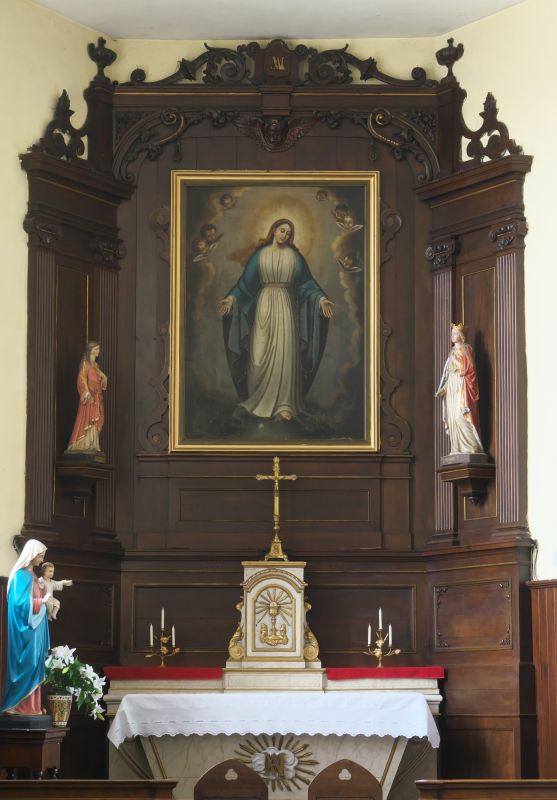
This statue of the Virgin and Child is part of traditional Marian iconography. Mary is shown standing, wearing a golden tunic covered with a blue mantle edged in red, the colours symbolising divinity, fidelity and royalty respectively. Her head is covered by a white veil, representing the purity of the Virgin. Her serene face expresses maternal benevolence. In her arm, she holds the Child Jesus, who is wearing a globe topped by a cross, a reminder of his role as Saviour of the world.
In her left hand, Mary holds a sceptre, emphasising her status as Queen. The base of the statue features a monogram in gold letters on a blue background surrounded by a classic ornamentation, “AM”, meaning “Ave Maria”.