
Our Lady of Foy
Route nationale 1334
59310 Coutiches
Church | 1820-1823 | Neoromanesque | Catholic Church


Map
Opening hours
01 January - 31 December
Mon 9.00 - 17.00
Tue 9.00 - 17.00
Wed 9.00 - 17.00
Thu 9.00 - 17.00
Fri 9.00 - 17.00
Sat 9.00 - 17.00
Sun 9.00 - 12.30
Description
Its relatively recent history contrasts with that of the commune, whose origins date back to Antiquity. Gallo-Roman ceramic workshops have been discovered during archaeological excavations.
The first documented church dates back to before the 12th century. At the time, it belonged to the Marchiennes abbey, which was itself attached to the diocese of Arras. The latter donated the church of Coutiches to Bourbourg Abbey in the 12th century.
Nothing has survived of this building, but an illustration dating from 1607, preserved in the Croÿ albums, offers a glimpse of it. At the heart of the village stands the long spire of a two-aisled church. The Chapelle des Fièvres can also be seen in the distance.
Records show that the church was already dedicated to Notre-Dame when, in the 17th century, the parish priest Blauwart added the name ‘De Foy’, in homage to the recent and important Belgian pilgrimage bearing that name.
During the French Revolution, the church was sold as national property to a Douais resident, who had it completely demolished in order to salvage the materials.
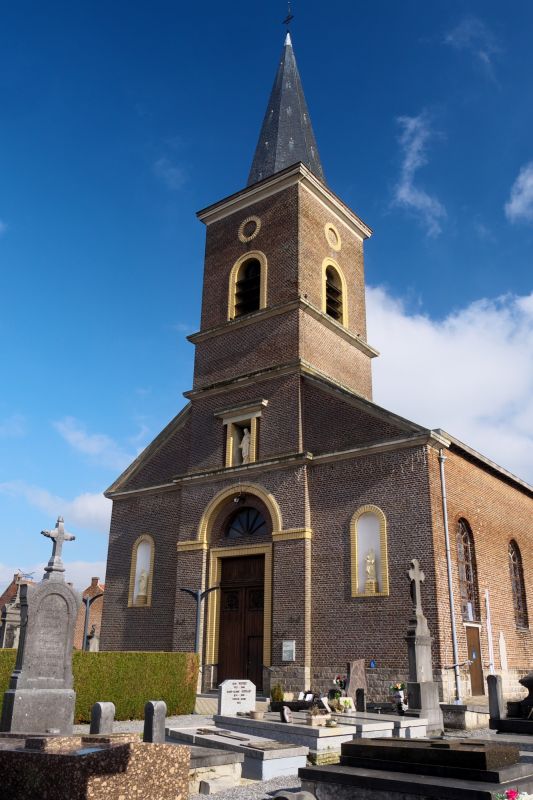
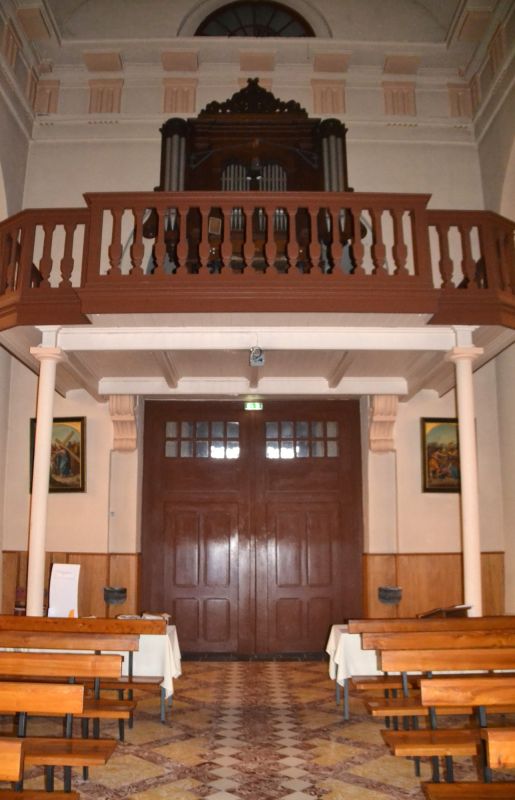
It was not until 1823 that a new building was constructed by the local architect Bonlet, based in Douai. The church was built in brick in a total neo-Romanesque style. A new spire was added in 1855 by the architect Louis Colbrant.
Photos

Remarkable elements

Stations of the cross
It was created by the famous Belgian painter and sculptor Pol Bury (1922-2005).

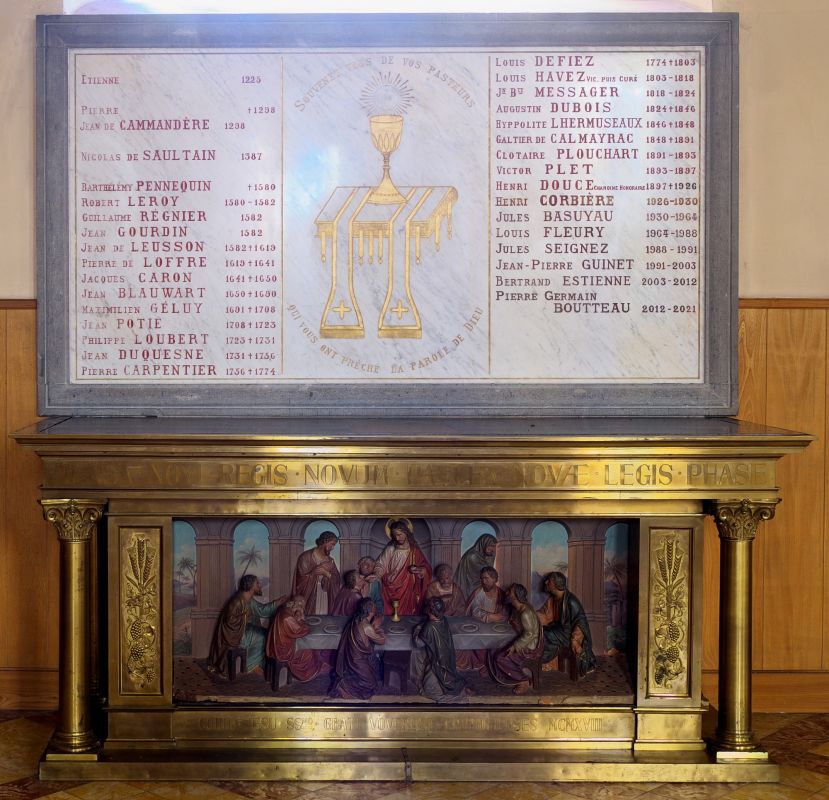
The Last Supper
A bas-relieved oak panel probably dating from the 17th century.
This panel was discovered following the retreat of German troops in 1918.
The scene depicts Christ surrounded by his 12 apostles at his last meal before his arrest.

Virgin and Child, known as Notre-Dame-de-Foy
This 18th-century polychrome wooden statue depicts Our Lady of Foy, whose cult originated in Belgium in the early 17th century. Discovered in 1609 inside the trunk of a tree near Wanlin, the original statuette quickly attracted numerous pilgrims. The shrine’s reputation grew following the first recognised miracle in 1616, making Our Lady of Foy a major figure in popular devotion.

18th-century wooden statues
These statues, placed above carved and gilded wooden altarpieces, are protected as historic monuments.
One depicts Saint Catherine, the other Saint Roch, not with his traditional dog, but accompanied by an angel.

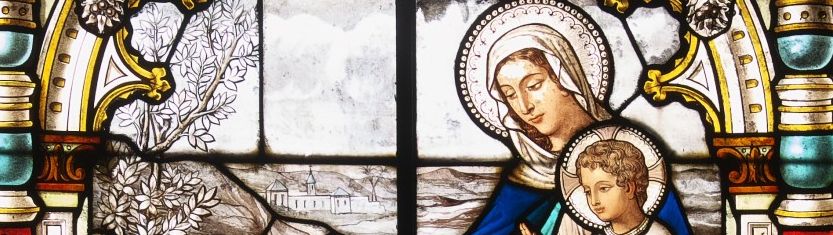
Notre-Dame des Fièvres stained glass window
Donated by families in the parish, these stained-glass windows depict various saints. One of them is dedicated to Our Lady of Fevers, whose local cult is still very much alive. Originating around a spring reputed to cure fevers – venerated since ancient times and later Christianised in the Middle Ages – this pilgrimage is still marked today by an annual novena and serves as a reminder of the area’s spiritual history.