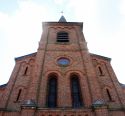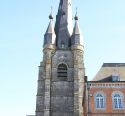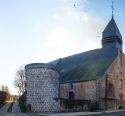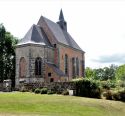

Saint-Médard (Immaculée Conception)
Place Stroh
59440 Dourlers
Church | 1864 | Neogothic | Catholic Church

Map
Opening hours
01 January - 31 December
Mon 11.00 - 18.00
Tue 11.00 - 18.00
Wed 11.00 - 18.00
Thu 11.00 - 18.00
Fri 11.00 - 18.00
Sat 11.00 - 18.00
Sun 11.00 - 18.00
Religious offices
Description
The interior of the building is marked by the height of the nave, which opens onto a choir where the eye follows the journey of Christ: from the descent from the cross (central stained-glass window) to the burial (celebration altar and high altar). The rest of the furnishings follow this neo-Gothic style (pulpit, side altars, confessionals). The presence of a chapel recalls the place of the great seigneurial families, the last of which – the Bourbon-Bussets – remained owners of the château until the 1970s.
Stroll through Dourlers Church and admire the decorative details: murals, stained glass windows, statues...
After visiting the church, take the time to explore the village, which still boasts a wealth of heritage sites: the Saracen Wall, the hamlet of Mont-Dourlers and Saint-Julien Chapel.
*The commune took the name Wattignies-la-Victoire after the battle of 1793.
Translated with www.DeepL.com/Translator (free version)
Photos


Remarkable elements

The pulpit
Finely carved in the neo-Gothic style, it was moved to the back of the church, probably after the Second Vatican Council. It has been listed as a historic monument since 1980.
Translated with www.DeepL.com/Translator (free version)

The Marquis Chapel
The Marquis de Nédonchel family settled in Dourlers in the mid-19th century. At the beginning of the 20th century, the seigneurial chapel – still separated from the church by a grille today – was decorated with stained glass windows by the artist Marc-Joseph Bulteau. Saints Michel, Joan of Arc, Louis and Jeanne de Valois (probably the latter) are depicted there, accompanied by the coat of arms and motto ‘Antiquitas et Nobilitas’ of the Nédonchel family.
Translated with www.DeepL.com/Translator (free version)

The murals
On the walls of the choir are a series of murals symbolising Christianity:
- the pelican representing Christ's sacrifice for the salvation of mankind,
- the chalice containing the consecrated host representing Faith,
- the good shepherd giving his life for his sheep,
- the fish, when linked to bread, is associated with the Eucharist,
- the trigram composed of the three Latin letters IHS, which means ‘Jesus, Saviour of mankind’.
Translated with www.DeepL.com/Translator (free version)

The oculus
A work by stained glass artist Marie-France Willot depicting a blue dove in a quatrefoil. This stained glass window was unveiled in 2022.
Translated with www.DeepL.com/Translator (free version)

The side chapel dedicated to Saint Médard
On this altar stands a statue of Saint Médard dating from 1517. The cult of Saint Médard spread throughout Flanders, where he was bishop in the 6th century. According to popular tradition, Médard is invoked against excessive rain and is the subject of the proverb ‘if it rains on Saint Médard's Day (8 June), it will rain for 40 days’.
The presence of this altar adds to the confusion surrounding the official name of the church: Saint Médard or Immaculate Conception?
Translated with www.DeepL.com/Translator (free version)