
Our Lady
Place Leclercq
62820 Libercourt
Church | 1881 | Neogothic | Catholic Church


Map
Opening hours
01 January - 31 December
Mon
Tue 10.00 - 11.00
Wed
Thu
Fri
Sat
Sun
The installation of a glass door in the forecourt allows you to see the interior of the church outside opening hours: from March 1 to October 1, Tuesday to Sunday, from 10 am to 6 pm.
Opening on August 15 from 10 am to 5 pm on the occasion of the Procession.
Description
Repeated attempts to move the statue ended in the same way: it always returned to its starting point. This hallot then became a place of worship, where the first chapel was built in the 12th century. It can still be seen today behind the current church on Rue du Cimetière.
A few hundred metres away, a second chapel was built in the 16th century by François de Melun, Lord of Epinoy[LS-EO2.1]. It was immortalised by Adrien de Montigny in 1610 in the Albums de Croÿ. During the French Revolution, this chapel was stripped of its ornaments and some of its furnishings, and the original statue of the Virgin Mary disappeared and was replaced by a copy.
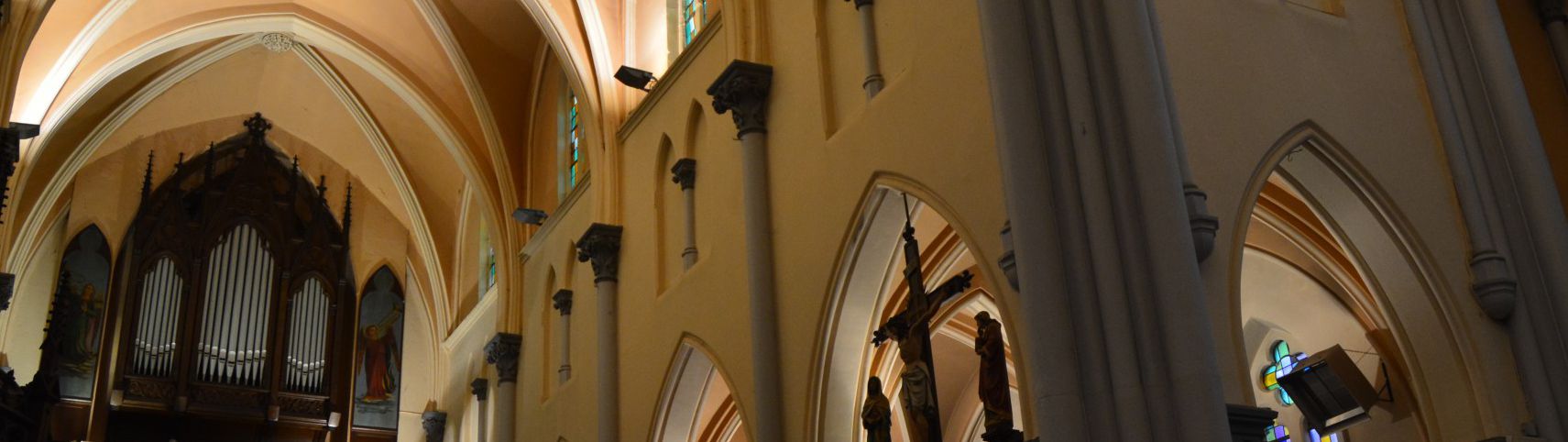
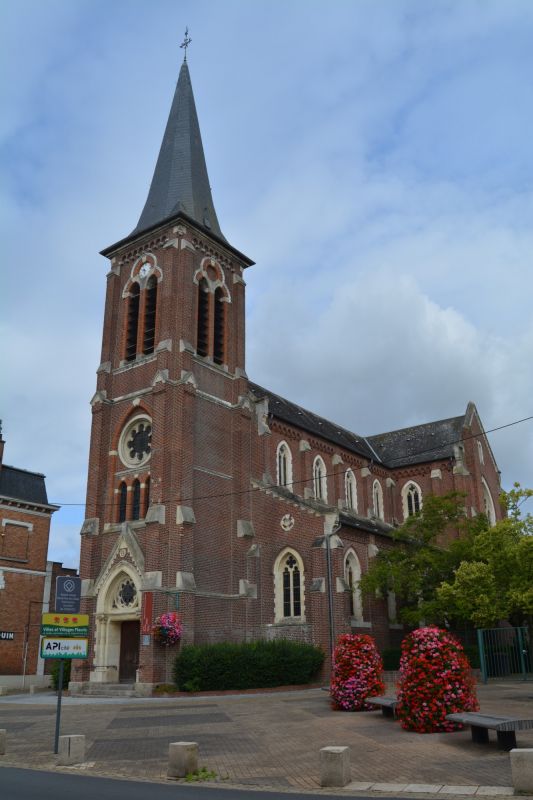
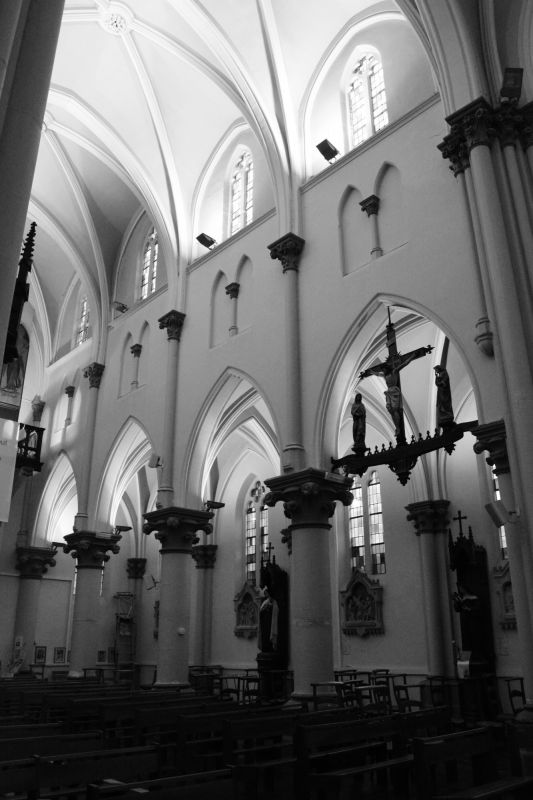
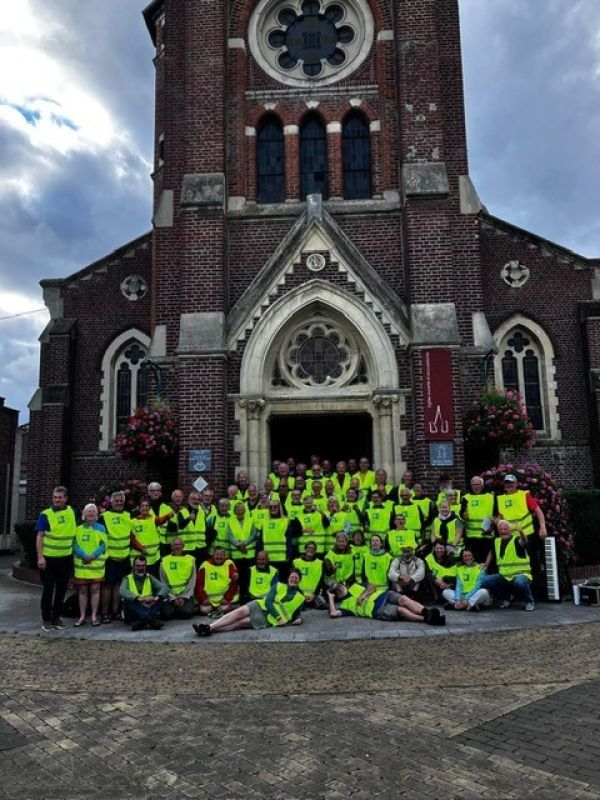
In the 19th century, the development of mining led to a massive influx of new populations (of Polish origin). In 1881, a third building dedicated to Our Lady was constructed by architect Jean-Baptiste Cordonnier perpendicular to the old church, retaining certain elements such as the large stained-glass window on the right-hand side. The interior combines neo-Gothic architecture and antique (or 19th-century) furnishings to form a harmonious whole: baptismal fonts from the second chapel, a stone high altar featuring a copy of the statue of the Virgin Mary, and a rood beam dating from 1901.
Translated with www.DeepL.com/Translator (free version)
Photos

Remarkable elements

Neo-Gothic furniture
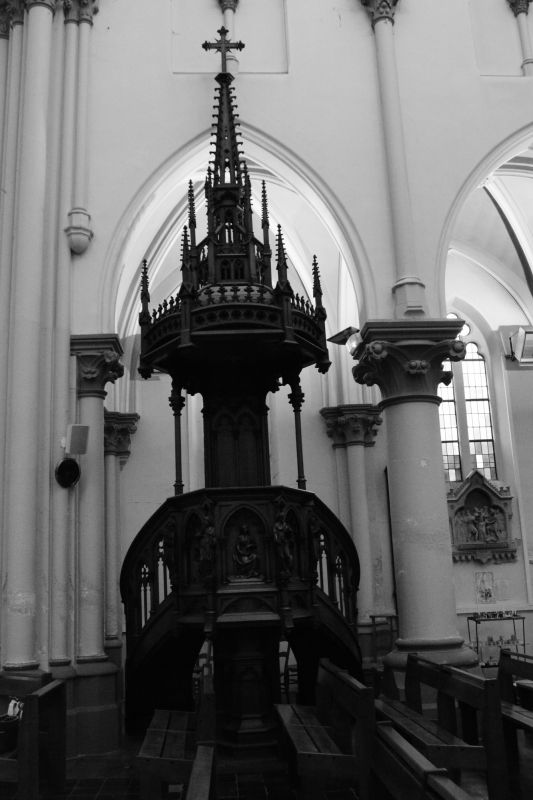
All of the wooden furniture in the church was made by the workshop of Gustave Pattein, a sculptor in Hazebrouck at the end of the 19th century. It includes the pulpit, the communion bench (which was dismantled and partially moved after Vatican II) and the confessional.
The stone furnishings are by Modeste Verlinden (originally from Antwerp, he set up his workshop in Roeselare around 1890). They include the high altar and side altars, the Stations of the Cross and two holy water fonts.
Translated with www.DeepL.com/Translator (free version)

The rood beam
This sculpture hangs beneath the arch of the fourth bay before the choir. It depicts Christ on the cross surrounded by Mary and Saint John. At the bottom is an inscription reading “Mission June 1901 – The grateful parish”.
Translated with www.DeepL.com/Translator (free version)

The paintings in the choir
Installed in the choir panelling, these paintings depict angels with halos kneeling and facing the high altar where the statue of Our Lady of Libercourt stands. They carry attributes such as scales, a cross, a sword, a book and two circular escutcheons representing the monogram of Christ with the letters I P and I C – X C.
Translated with www.DeepL.com/Translator (free version)

Paintings dedicated to the Virgin Mary
On the walls of the building, a series of 13 paintings by the artist Duquesne is dedicated to the Virgin Mary.
Translated with www.DeepL.com/Translator (free version)

The stained glass windows in the transepts
The stained glass windows in the north transept (on the right) depict scenes from the life of Christ: from his birth to the handing over of the keys to Saint Peter. On the other side, in the south transept (left), scenes from the life of Saint Teresa are depicted: from the apparition of the Virgin Mary to her entry into the Carmelite convent. These two windows are signed by the artist Largillier.
Translated with www.DeepL.com/Translator (free version)