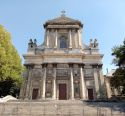

Saint Leodegar
rue Diderot
62300 Lens
Church | 1926 | Baroque, Neoclassical | Catholic Church

Map
Opening hours
01 January - 31 December
Mon 8.30 - 19.00
Tue 8.30 - 19.00
Wed 8.30 - 19.00
Thu 8.30 - 19.00
Fri 8.30 - 19.00
Sat 8.30 - 19.00
Sun 8.30 - 19.00
Religious offices
Description
The first church is recorded as early as the 11th century, built by the Counts of Boulogne and Lens. With its medieval appearance, it was immortalised in the Albums de Croÿ in the 17th century, a period when the first signs of instability led to the collapse of the tower. A major reconstruction was undertaken from 1779 onwards.
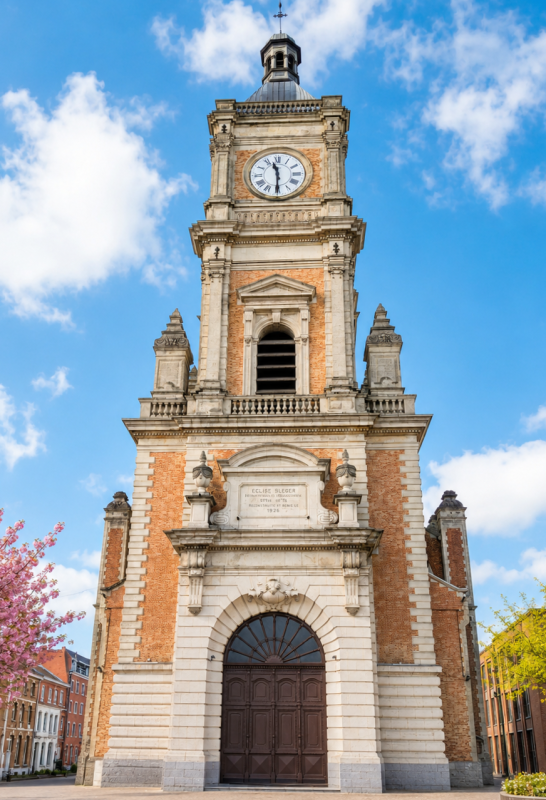
In the 19th century, the boom in coal mining transformed Lens and the mining basin. The mass influx of foreign workers led to the creation of mining towns, each with its own church. On the eve of the First World War, the town had a population of nearly 35,000 and eight churches. Located in the town centre, Saint-Léger then established itself as one of the main urban landmarks. The town was then quickly occupied, and the church, used as an observation post, was completely destroyed in January 1916. In the aftermath of 1918, reconstruction was at the heart of debates in the town council, which initially rejected the project. It took the impetus of the MP and mayor, Émile Basly, to approve the reconstruction, which was entrusted to the architects Jean Goniaux and Pierre Delannoy. Work began in 1923 under the watchful eyes of the congregation, who gathered in a hut provided by Félix Bollart.
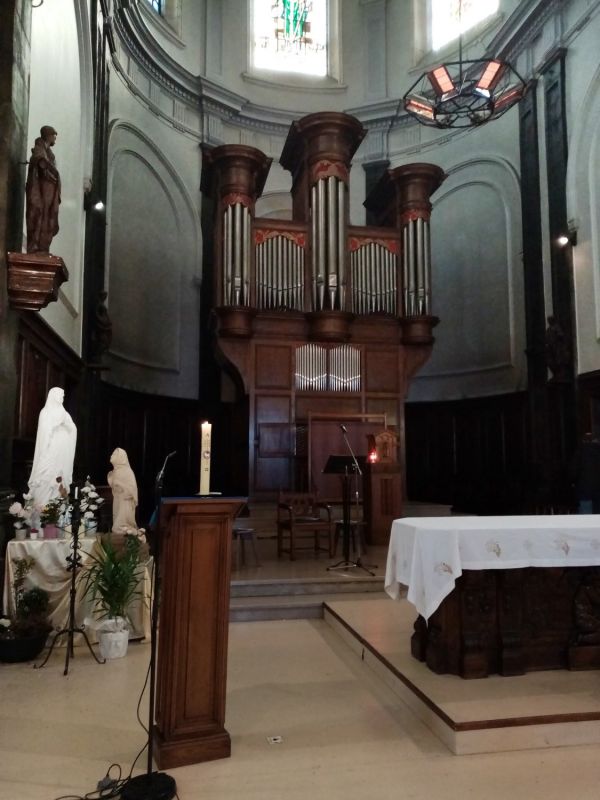
The church’s original location and appearance have been preserved. The innovation lies in the structure and a technique that became indispensable during the Reconstruction: reinforced concrete, which makes the walls lighter and helps to minimise ground subsidence. The church thus regains its French Baroque character whilst maintaining a decorative simplicity.
Photos