Saint Theodore
Rue Molière 51 bis
62300 Lens
Church | 1906-1924 | Contemporary | Catholic Church


Map
Opening hours
01 April - 31 October
Mon
Tue
Wed 14.00 - 16.00
Thu
Fri 14.00 - 18.00
Sat
Sun
01 November - 31 March
Mon
Tue
Wed 14.00 - 16.00
Thu
Fri 14.00 - 17.00
Sat
Sun
The building is opened by volunteers from the Saint-Théodore de Lens association. Exceptional closures may take place depending on the availability of these people.
Thank you for your understanding.
Guided tour
Religious offices
In winter, the last Sunday before Saint Barbara's Day.
Description
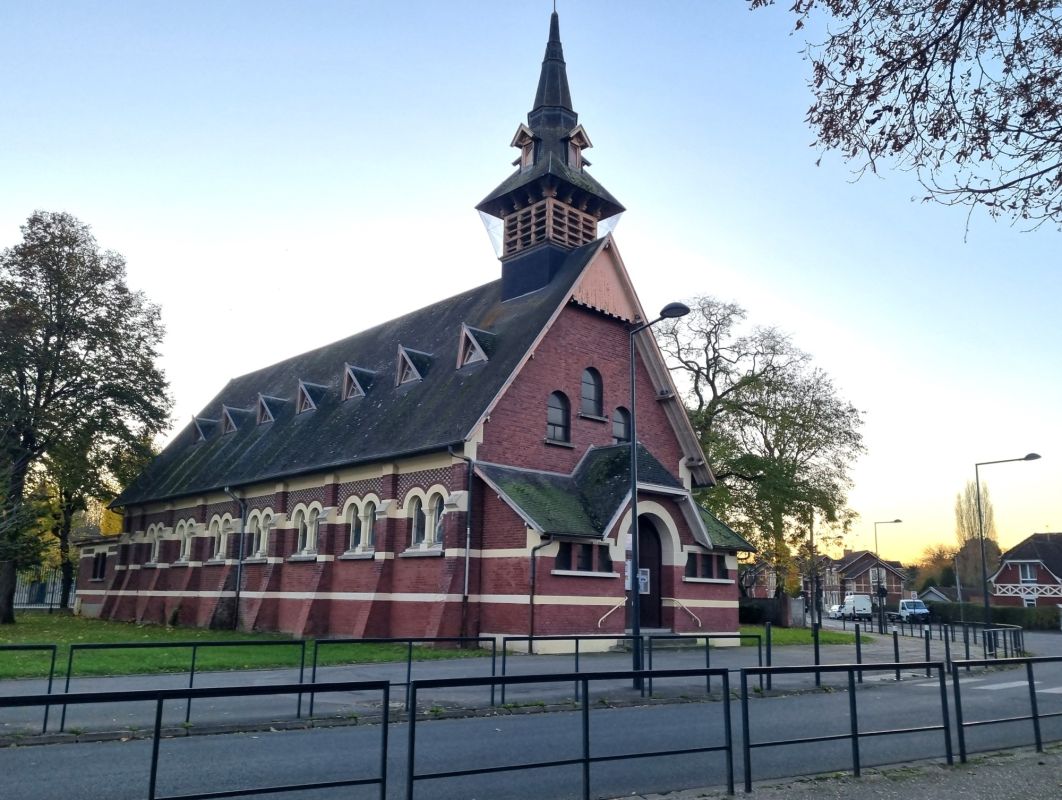
Situated in the heart of the Pas-de-Calais mining basin, a stone’s throw from the Louvre-Lens, Saint-Théodore Church bears witness to the region’s coal-mining history. When the mining basin was inscribed on the UNESCO World Heritage List in 2012, Jean-François Caron recalled that “here, man has dug, extracted and built mountains ”. Around here, the locals call these mountains ‘terrils’!
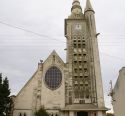
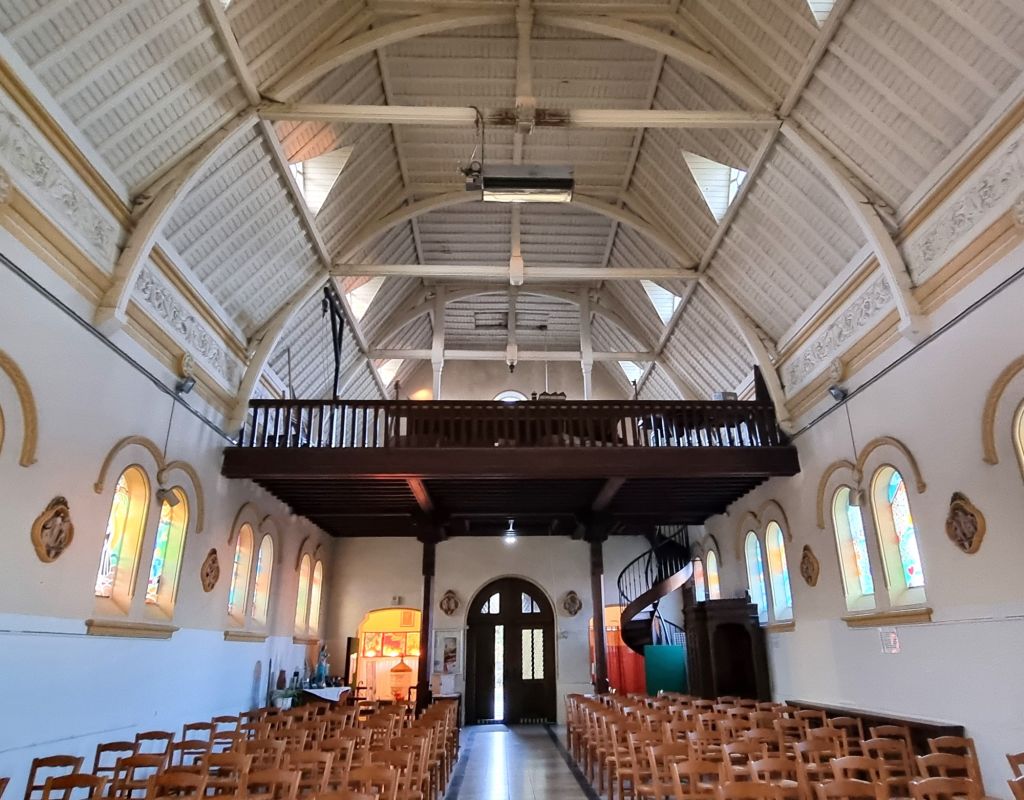
Near the numbered mining pits established as early as 1852, workers’ housing estates sprang up for families, soon followed by schools, hospitals and then religious buildings. A first chapel was built in 1910 by Jean-Baptiste Cordonnier. The Great War then ravaged the town, and the reconstruction of the church was entrusted to Louis-Marie Cordonnier, son of the previous architect. He designed a simple, harmonious building: a single nave covered by an inverted boat-shaped roof structure and a Scandinavian-inspired triangular façade dominated by a wooden bell tower.
Due to a lack of funds, the stained-glass windows originally planned were never installed. For nearly a century, plain panes of glass served in their place, until this inauguration in May 2024.
Translated with www.DeepL.com/Translator (free version)

Photos



Remarkable elements
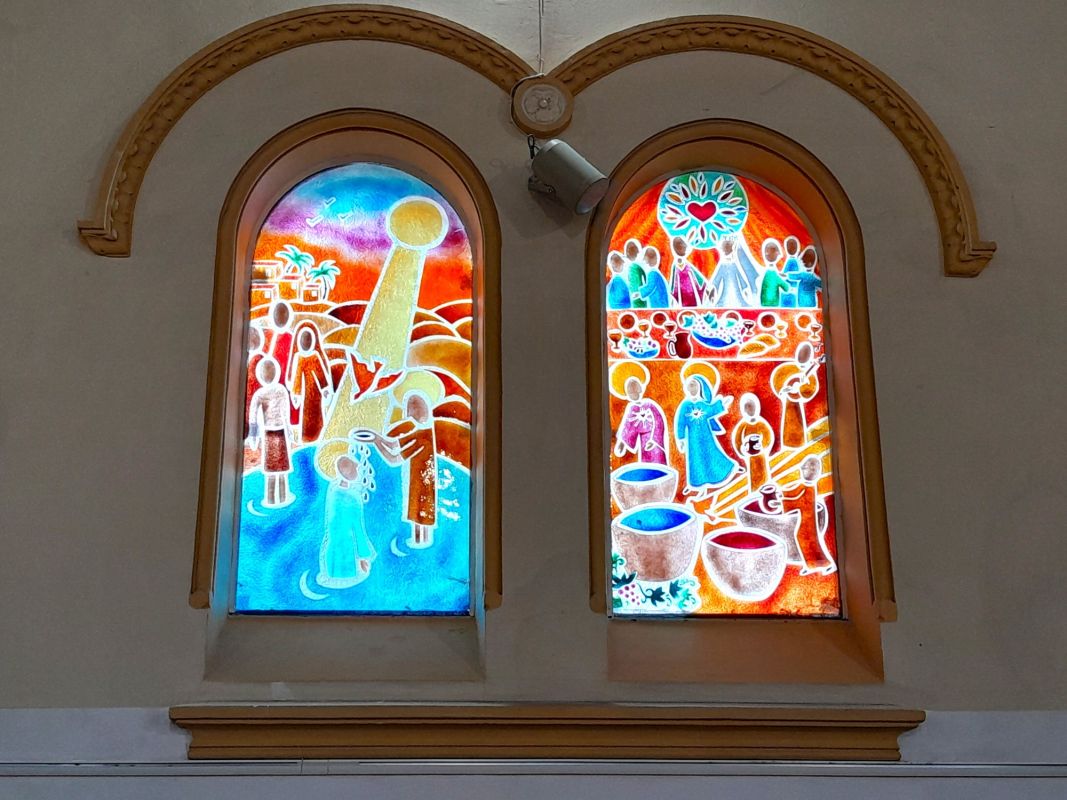
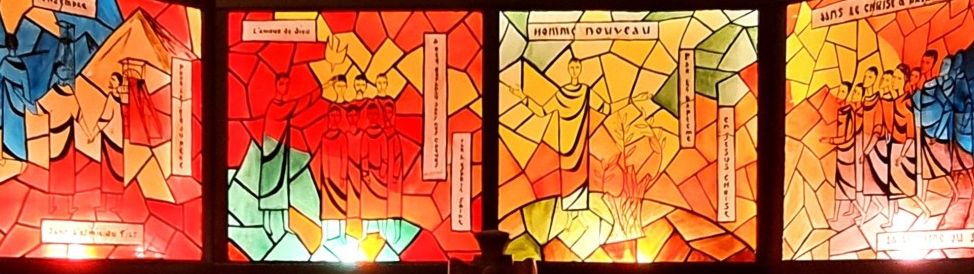
Stained-glass windows – from watercolour to stained glass
This series of stained-glass windows blends contemporary design, spirituality and the heritage of the mining region. Drawing on Lise Flipo’s watercolours, master glassmaker Thomas Masson has created colourful pieces with fluid lines and luminous colours, creating an interplay of transparency that engages with the building’s classical architecture.
Translated with www.DeepL.com/Translator (free version)

Stained-glass windows – composition and symbolism
They offer a colourful world dominated by a luminous palette of blues, greens and yellows, where nature, the play of light and biblical scenes inspired by Creation, Mercy and Hope intertwine. Inviting meditation or contemplation, these stained-glass windows create a dialogue between spirituality, the local heritage and the neighbourhood’s regeneration.
Translated with www.DeepL.com/Translator (free version)
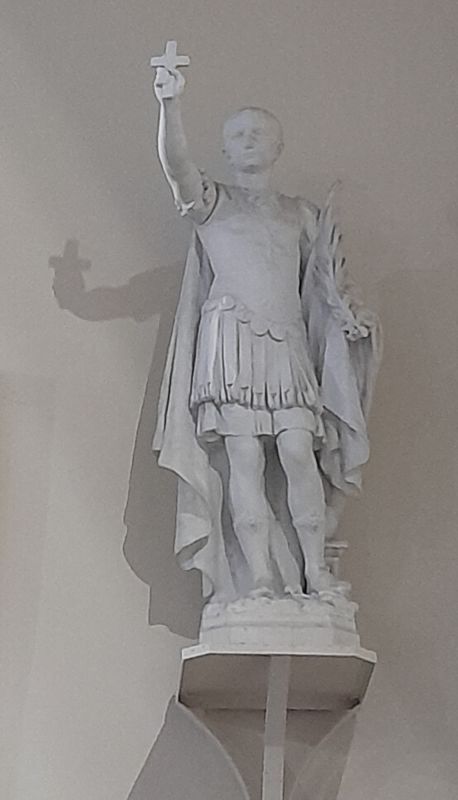
Statue with two references: Saint Theodore, known as the Recruit
In the late 3rd century AD, Theodore was a young soldier in the Roman army, probably originally from Amasya in modern-day Turkey. Having converted to Christianity, he refused to take part in the pagan rituals imposed on soldiers. Arrested following an act of vandalism, he was imprisoned, tortured and sentenced to be burned at the stake. He quickly became a great military martyr, invoked as the protector of soldiers and travellers.
Translated with DeepL.com (free version)

Statue with two references: Théodore Barrois (1857–1920)
A native of Lille, Théodore Barrois (the third of that name) was a brilliant scientist, doctor and zoologist. His family were shareholders in the Compagnie des mines de Lens, and he himself became a director of the company. Pit 9 in Lens was named after him, as were the housing estate and later the church dedicated to Saint Theodore. The Louvre-Lens now stands on the former site of Pit 9, a discreet and symbolic tribute to Théodore Barrois.
Translated with www.DeepL.com/Translator (free version)

Statue of Saint Barbara
A 3rd-century martyr, she converted to Christianity against her father’s will, who had her imprisoned in a tower (her attribute). In the mining region, she holds a key place as the patron saint of miners and those in dangerous trades. Her statues can be found both in homes (miners’ cottages) and in churches. She is celebrated on 4 December on Saint Barbara’s Day, a major festival commemorating mining heritage and working-class families.
Translated with www.DeepL.com/Translator (free version)

Art Deco furniture
The interwar period saw a revival of sacred art, with contemporary art being introduced into churches through a new artistic movement: Art Deco. Liturgical furniture adopted its general stylistic features: geometric forms and simplicity of decoration.
Thus, the altars, the confessional, the baptismal font and its grille, and the pulpit’s base, which became a pedestal for a statue, are a perfect example of the development of this artistic style in the provinces.
Translated with www.DeepL.com/Translator (free version)