

Saint Martin
rue de l'église
14340 Repentigny
Church | XII-XIII | Romanesque | Catholic Church


Map
Opening hours
01 January - 31 December
Mon 9.00 - 18.00
Tue 9.00 - 18.00
Wed 9.00 - 18.00
Thu 9.00 - 18.00
Fri 9.00 - 18.00
Sat 9.00 - 18.00
Sun 9.00 - 18.00
Guided tour
Religious offices
Description
The origins of the village are ancient: the place name suggests a Gallic root, later Latinised.
Surrounded by a hedge and a cemetery, the 13th-century church consists of a single nave, the first bay of which supports the bell tower, and a flat-ended chancel. It has undergone several renovations over the centuries and was enlarged in the 16th century with the construction of a seigneurial chapel, now the sacristy.
To the left of the door, which is often open, is the funerary monument dedicated to the children of Repentigny who died for France during the First World War.
But don't be fooled by the building's simple exterior: its interior amazes and surprises visitors with the quality and richness of its furnishings and works of art.

Photos


Remarkable elements

Altarpiece
Dating from the late 16th to early 17th century, this altarpiece, of Flemish origin, is the oldest in the Pays d'Auge region. Exceptional in its design and iconography, this polychrome wooden work consists of three parts. In the centre is the Last Supper; on either side, six panels illustrate the Passion of Christ, from the Arrest to the Resurrection. Remarkably, the reverse side reveals twelve panels depicting the life of Saint Martin.

15th-century Virgin and Child
This is the oldest work preserved in the church. This polychrome wooden statue, dating from the 15th century, depicts a crowned Virgin holding the Baby Jesus in her arms. The Virgin's supple posture and slight sway of the hips, characteristic of late medieval statuary, have earned her the name ‘Virgin with swaying hips’.
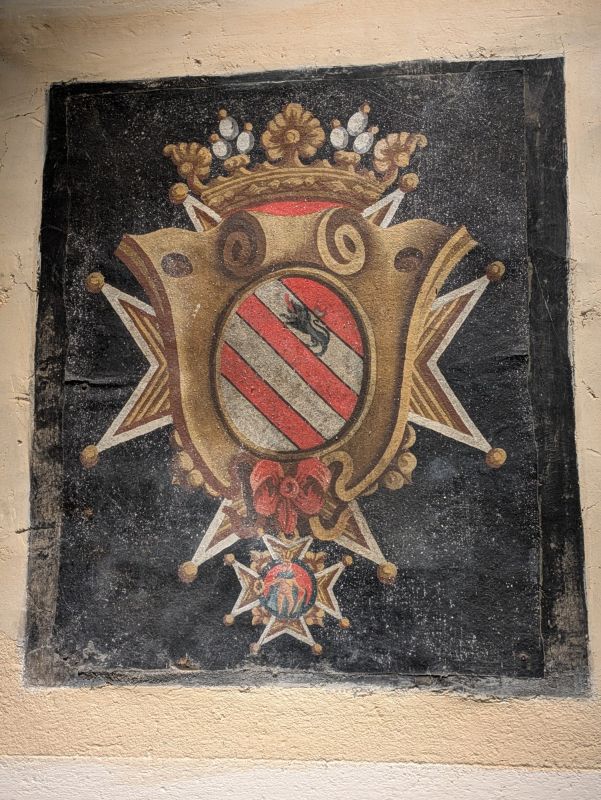
Funeral litter
These are temporary decorations created to honour the deceased. Installed during the funeral, they were removed one year and one day later. Since the Lateran Council (1215), they have symbolised the lords' right of patronage. Initially made of black fabric, over time they became painted strips, often decorated with coats of arms. Abolished in 1791, this practice survives here with the arms of the Dauvet lords, dating from the 18th century, surrounded by the Order of Saint Louis.

Antependium
The antependium of the north side altar, dedicated to the Virgin Mary, is a remarkable example of 17th-century painting on canvas. It features the dove of the Holy Spirit at the centre of a refined decoration of foliage, roses, tulips and leaves. This work can be attributed to the painter Jean-Baptiste Daubin, whose workshops were based in Lisieux.

Foundation plaques for masses
These plaques commemorate donations made by the faithful to ensure regular prayers for the repose of their souls. Very common in the 16th and 17th centuries, they specify the name of the founder, the rents granted and the obligations of the clergy. In Repentigny, the plaque from 1601 bears witness to the piety of Guillaume Martin, who established weekly Masses and prayers at his grave.
The ‘Libera me’ is a prayer sung to ask God to deliver the soul of the deceased.

Painting of the Erection of the Cross
Smaller than the original painting by Charles Le Brun for the collection of King Louis XIV, this work is a copy made at the Louvre by the Caen painter Maurice Le Cesne between 23 November and 23 December 1900 for the church of Repentigny. Le Brun's original painting is now kept at the Museum of Art, Archaeology and Natural Sciences in Troyes.


