Saint Aubin
Chemin des Vallées
14140 Vieux-Pont-en-Auge (Saint-Pierre en Auge)
Church | IX-X | Carolingian | Catholic Church


Map
Opening hours
01 November - 14 March
Mon 9.00 - 17.00
Tue 9.00 - 17.00
Wed 9.00 - 17.00
Thu 9.00 - 17.00
Fri 9.00 - 17.00
Sat 9.00 - 17.00
Sun 9.00 - 17.00
15 March - 31 October
Mon 9.00 - 19.00
Tue 9.00 - 19.00
Wed 9.00 - 19.00
Thu 9.00 - 19.00
Fri 9.00 - 19.00
Sat 9.00 - 19.00
Sun 9.00 - 19.00
Guided tour
Religious offices
Description
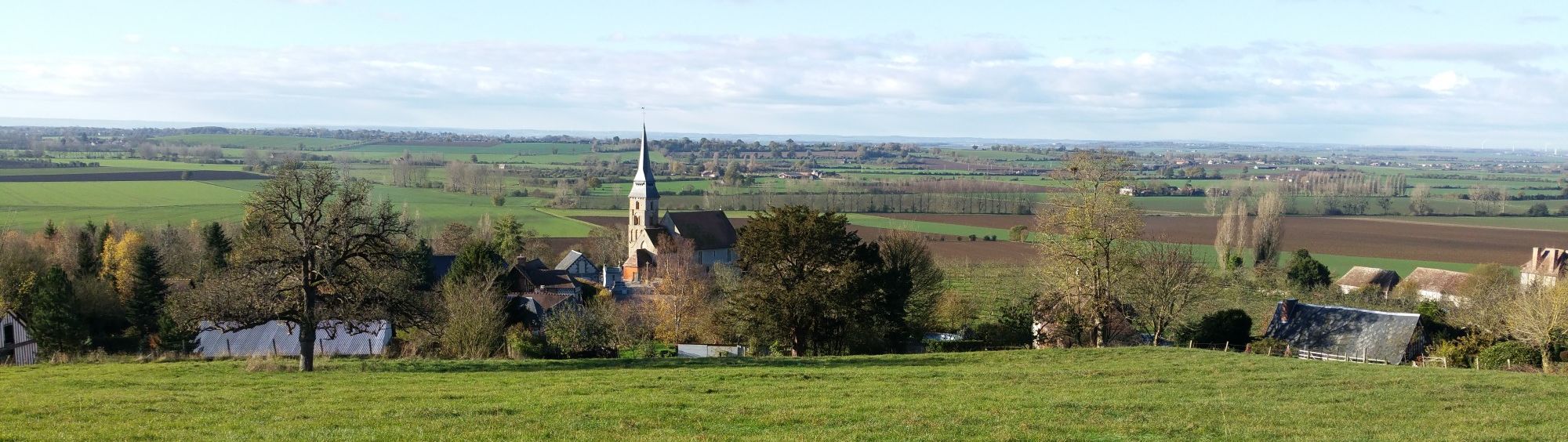
Overlooking the countryside of the Pays d'Auge, the steeple of the church of Saint Aubin in Vieux-Pont-en-Auge, a delegated commune of Saint-Pierre-en-Auge, draws the eye and invites visitors to push open the door of one of the oldest religious buildings in Normandy.
The church was built in the Carolingian period, between the 9th and 10th centuries. Its distinctive masonry, composed of stone rubble bonded with mortar and embellished with three rows of red brick, is a rare and emblematic feature. This technique, which originated in Roman times, has also been seen in military enclosures such as Le Mans and the Cluny thermal baths in Paris. Thermoluminescence analyses have revealed that these bricks date from between 300 BC and 700 AD, testifying to the reuse of ancient materials during construction.
Construction of the church continued into the Romanesque period, as evidenced by the 11th-century upper floors.
The interior of the church is also full of surprising details. If you look up at the ceiling of the nave, you can see the carved ragers at the ends of the beams. On the left wall, an enfeu with a semicircular arch also catches the eye.
For more information, visit the association's website: https://vieuxpontenauge.fr/

Photos


Remarkable elements

Ranoldus obituary plaque
Visible on the tower, this Latin memorial stone, carved in Carolingian script, commemorates Ranoldus, regarded as the founder of the church. He died in 885, but the inscription was carved later, around the turn of the 9th and 10th centuries, a period that matches the construction of the church walls. Such memorial stones, intended to preserve the memory of the deceased, are now extremely rare in Normandy.

Polychrome statuettes
At the entrance to the church, two polychrome stone statues from the 16th century are on display:
- the first depicts Saint Martin dressed in 16th-century fashion, on horseback, sword in hand. The features of the faces, the horse and the clothes are very well done.
- The second depicts a Holy Trinity or Throne of Glory. The Father, wearing a tiara, is seated on a throne adorned with fleur-de-lys, holding the crucified Christ, with the dove of the Holy Spirit under his beard.

The miracle of Saint Aubin’ painting
This late 17th-century painting depicts Saint Aubin bringing a stillborn child briefly back to life so that it could be baptised, reflecting the former belief in the “sanctuary of respite”. It is remarkable for the alterations made during the First French Republic (1792–1804), when Republican symbols were added: the French tricolour, a sans-culotte’s pike and a fasces. A small soldier firing a cannon may be the restorer’s signature.

The high altar and side altarpieces
These carved wooden altarpieces from the 17th and 18th centuries are among the church’s treasures. The high altarpiece revealed early 20th-century Sacred Heart paintings during restoration. The north altarpiece features the Return from Egypt, inspired by Rubens, with the unusual depiction of the Virgin Mary as pregnant. The south altarpiece illustrates Saint Martin sharing his cloak with a beggar.

The funeral litre
In the north-west corner of the nave remain traces of the funeral hatchment of the last Lord of Vieux-Pont. Under the Ancien Régime, a black band bearing the deceased lord’s coat of arms was painted inside the church as a sign of mourning. The shield, supported by two unicorns and topped with a baron’s coronet, belongs to the Dunot family, owners of the Barony of Vieux-Pont in the 18th century.

Graffiti
Curious graffiti decorate several of the church's stones, both inside and out. In particular, there are several engravings of deer and, to the north, at the corner of the nave and the choir, a curious quadruped with the head of a snake swallowing its tail.