
Saint Landelin
Place Jules Bacq et du 11 Novembre
59269 Quérénaing
Church | XII-XVI-XVII | Romanesque, Gothic | Catholic Church


Map
Opening hours
01 January - 31 December
Mon 10.00 - 17.00
Tue 10.00 - 17.00
Wed 10.00 - 17.00
Thu 10.00 - 17.00
Fri 10.00 - 17.00
Sat 10.00 - 17.00
Sun 10.00 - 17.00
Religious offices
Description
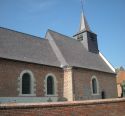
The church has ancient origins, as evidenced by the name of its patron saint: Saint Landelin. Living in the 7th century, this curious character converted after leading a life of banditry. Having become a hermit, his reputation attracted many companions, leading him to found the abbeys of Lobbes (Belgium) and Crespin.
In 1236, the first chapel was built by Nicolas Roussiau, knight and lord of Quérénaing. It became a parish church and underwent several modifications.
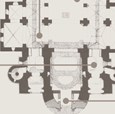
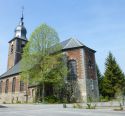
In its current state, the building has a nave and choir built in the 16th century in Gothic style. Built in sandstone, it has retained its pointed arch windows and its Paradise door. The nave is shaped like a ship's hull. The panelled vaults are supported by curved beams decorated with sculpted figures, rediscovered during successive restoration work.
Although of considerable architectural interest, the hurricane of 1876 compromised its classification as a Historic Monument.
A visit to the church of Quérénaing combines a true retrospective of local history with its spiritual roots and shows the determination of the inhabitants to preserve, promote and pass on this meaningful shared heritage.
Translated with www.DeepL.com/Translator (free version)

Photos


Remarkable elements

The baptismal font
This baptistery is made from a single piece of cut sandstone. The octagonal basin, inscribed with the date 1569, rests on a 6-sided column and an 8-sided foot. This ensemble has been protected as a Historic Monument since 1986.
Translated with www.DeepL.com/Translator (free version)

Paradise Gate
On the north side is the site of the door, known as ‘In Paradisum’, leading to the cemetery that surrounded the church until 1903. The In paradisum is one of the Gregorian antiphons sung at the end of the funeral ceremony, when the coffin of the deceased is accompanied in procession from the church to the cemetery. This is why it is also known as the ‘Gate of the Dead’.
Translated with www.DeepL.com/Translator (free version)

The statue of the Virgin and Child
This gilded and polychromed wooden statue dates from the 18th or 19th century. Protected as a Historic Monument since 1986, this Virgin and Child embodies the link between the divine world and humanity.
Translated with www.DeepL.com/Translator (free version)

Liturgical pools (or washbasins)
In a niche in the choir are two shell-shaped basins. These were used by the priest to wash his hands before handling and purifying offerings, which could be in kind. This practice continues today in a symbolic gesture during the lavabo, when the priest wets only his fingertips.
Translated with www.DeepL.com/Translator (free version)

The stained glass windows
The stained glass windows in the nave and choir were designed by Marie Payen and inaugurated in 2024. Above the door, Saint Landelin welcomes visitors with open arms.
The stained glass windows in the nave are decorated with medallions. The south side depicts major biblical stories and the story of creation. The north side depicts scenes from the life of Landelin.
The exit is accompanied by a stained glass window inviting visitors to follow in the footsteps of the pilgrims of Saint James.

The stained glass windows in the choir
In the choir, a first stained glass window dominated by blue depicts the Virgin Mary above a village in flames. She guides 20 stars towards the sky, in memory of the victims of 25 August 1914, and a blue star commemorates the sole survivor.
Opposite, the parable of the sower occupies almost the entire space in warm colours reminiscent of wheat and barley harvests.
Translated with www.DeepL.com/Translator (free version)