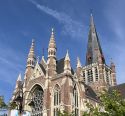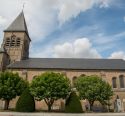

Saint Bavo
Dorpsstraat 47
8840 Westrozebeke (Staden)
Church | 1926 | Neogothic | Catholic Church


Map
Opening hours
01 January - 31 December
Mon 8.00 - 18.00
Tue 8.00 - 18.00
Wed 8.00 - 18.00
Thu 8.00 - 18.00
Fri 8.00 - 18.00
Sat 8.00 - 18.00
Sun 8.00 - 18.00
Religious offices
Description
Westrozebeke is best known for the Battle of Roosebeke (1382), in which the Flemish suffered a crushing defeat against the French. According to local legend, a red thread encircled the village and protected its inhabitants from the horrors of war. The seven points where it was fastened are commemorated today by the seven chapels along the Ommegang procession route. Since the battle, devotion to Our Lady of Roosebeke has remained strong.
Little is known about the church’s early history, though a stone church likely stood here as early as the 12th century. Part of the building was damaged during the Iconoclastic Fury of 1566. Around 1740, the old church was demolished and replaced by a new one, which was completely destroyed during World War I. The present church is a reconstruction dating from the 1920s.
The choir houses the statue of Our Lady of Roosebeke, which attracted many pilgrims over the centuries. The original statue was reportedly moved from a forest chapel to the church in 1383 after the battle, but it was destroyed during the Iconoclastic Fury. The current 16th-century statue was safely removed during World War I and temporarily housed in Saint Michael’s Church in Roeselare while the church was being rebuilt.
The white-plastered hall church originally featured a fresco in the northern choir depicting an allegorical representation of Roosebeke supported by two angels.
The stained-glass windows in the southern choir are dedicated to Saint Joseph, while those in the northern choir honour Our Lady of Roosebeke.
Photos


Remarkable elements

Choirs
The white plastered wall of the northern choir contains a fresco: a parchment crowned with a shield, showing the allegorical representation of Roosebeke, held by two angels. The glass windows in the southern choir are dominated by Saint Joseph, the ones in the northern choir by Our Lady of Roosebeke.
Sculpture of Our Lady in Westrozebeke
After the original sculpture from the 14th century was destroyed by the iconoclasts in 1566, a few years later a new oak sculpture (the current) was made of precisely 1 metres in height. It was polychromed and was decorated in several different ways during the following centuries. After World War I it was installed in the newly built church. Originally, on the left side altar, later high above the head altar and since 2002 on the location where it had always stood during World War I.
Organs
In 1936, Jules Anneessens of Menen built the loft organ with two manuals, pedalboard and 18 stops. Its pneumatic action was renovated in 1987 and is still maintained by Paul Andriessen. A choir organ, built in 1980 by Philippe Busschaert of Kortrijk, stands at the front of the church. It has mechanical action and 6 stops. Both instruments are used for liturgical services and are also played by internationally renowned organists during concerts.

Stained-glass windows
The left stained-glass window in the north choir depicts Philip the Bold and Margaret of Male, who came to Westrozebeke in 1384 and established a procession in gratitude to Our Lady after the Battle of Westrozebeke in 1382. The right window shows a chapel with Our Lady of Westrozebeke and the church tower in the background. In the south choir, a stained-glass window portrays Christ blessing Saint Joseph on his deathbed, with Mary, a lily symbolising purity, and a praying angel.

Crucifix with Jesus ressurected
As a result of the redecoration of the choir and the displacement of the statue of Our Lady, the idea starts to hang a giant crucifix above the altar. At the request of the pastor, it was decided to go for a cross with Christ resurrected on it, which was also a first for Flanders. The order to make this was given to the art sculptor Donaat Vanoverschelde from Zarren.
“Ex-voto” or the painting of Sussex
On 24 March 1916, the packet boat Sussex, sailing from England to France, was struck by a German torpedo. Among the 320 passengers were 11 people from Westrozebeke. The French fishing boat Marie-Thérèse rescued 192 survivors, including all 11 who had prayed to the Virgin Mary. In gratitude, survivor Albert Debaes painted this scene in 1934 from a photograph published in Le Miroir. The painting was then carried each year in the Marian procession.

Art Deco candle sticks and light fixtures
Four copper candlesticks bearing the coat of arms of Menen stand on the high altar. Dated 1935, each rests on three reclining lions. On either side are large copper candelabra: the largest, decorated with blue stones, carry 19 electric candles inscribed “Meenen 1937”. All are adorned with stylised vine leaves and grape clusters in Art Deco style. These and other candlesticks in the church were donated by pilgrims from Menen.