Saint James the Greater
Place de la Halle 1
4890 Clermont-sur-Berwinne (Thimister)
Church | 1632 | Gothic, Renaissance | Catholic Church


Map
Opening hours
31 May - 31 May
Mon
Tue
Wed
Thu
Fri
Sat 10.00 - 18.00
Sun 10.00 - 18.00
Religious offices
Description
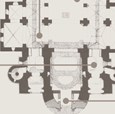
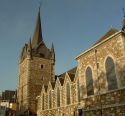
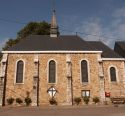
The church is a massive, imposing edifice, marked by the medieval tower of the 12th and 13th centuries, and it is still imposing today. We know that the first church dates back to before 1280. It had a defensive function for the population of the time. The current, larger church was built between 1628 and 1633. It retains a transept and chancel dating from 1567.
The variety of styles visible in the same building is unusual: the main building of the church was built in the Gothic style for the naves, the ogival style for the choir and the Mosan Renaissance style for the tower. At the height of the War of Religion, the church's scale, decoration and wealth made it a proud Catholic bastion against the Protestant world north of Clermont.
It possesses a treasure trove of great wealth, which is referenced and currently kept at the Grand Musée Curtius in Liège. Some of its works of fine silverware and rare silks are considered exceptional and are on permanent display there.
The patron saint, Saint James the Greater, was the originator of the pilgrimage to Santiago de Compostela. This explains why pilgrims from the north have been passing through the church for 700 years. In addition to its high-quality furnishings, the church contains relics of Saint James, Saint John and the Cross of Christ.
The church was listed in two stages: the choir, transept and narthex were among the first groups of listed monuments in Belgium on 15 March 1934. The rest of the sanctuary and the cemetery were listed on 12 October 1983. It also crowns one of the most beautiful villages in Wallonia and dominates its square.


Photos


Remarkable elements

The main altar
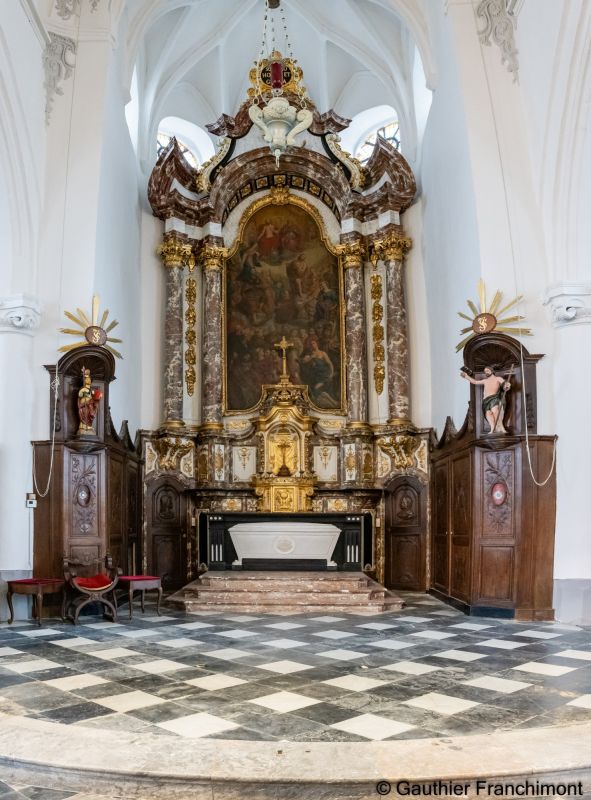
This elegant ensemble evokes the great Baroque works of Germany and Austria. Around 1730, a black marble altar with a white marble sarcophagus was built. Supported by four faux marble columns, a monumental crown frames a 4 × 2.10 m retable showing Saints gathered before the Holy Trinity. The work is signed in the lower right, and the inscription Soli Deo Honor et Gloria adorns the whole.

The baptismal font
Dating from before 1280, the font originally stood in the cemetery outside the first church. Returned in 1913, it was first placed in the narthex baptistery and now stands in the choir at the front of the northern aisle. Carved from a single marble block, it features a circular basin with four slanted heads bearing mascarons, likely symbolizing the four rivers of Paradise, supported by a central sandstone column.

The organs
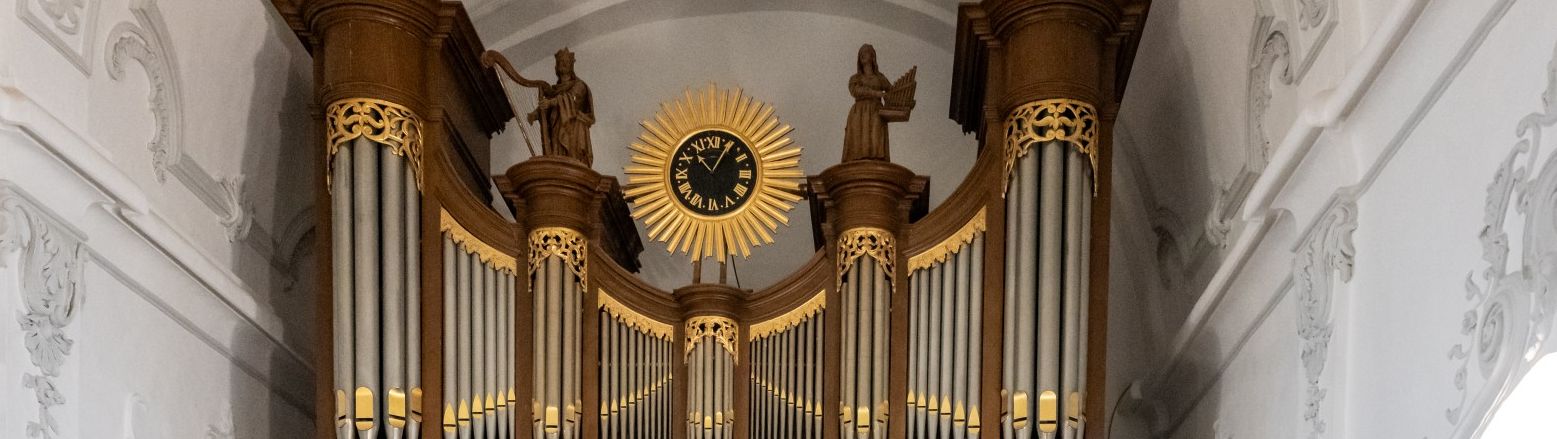
Parish records first mention the organ in 1736. Installed in 1737, it was funded partly by donors, and the village approved using trees from the forests of Clermont for its construction. The instrument was restored in 1851, 1894, and 1974. During the latest restoration, its many high quality original parts were preserved and enhanced with essential new stops. These organs are considered unique and renowned.

The pulpit
Built in 1768 by R. Delcommune, the pulpit reflects the elegant Louis XV style inspired by nature, with flowing curves, asymmetry, and delicate motifs like shells and foliage. Nine sculpted symbols adorn the tub, baluster, and baldachin. The column shows Saint James the Great in pilgrim’s habit, enraptured by the Virgin’s apparition, rays shining from her aureola—almost like clues for an escape room.
Stuccoes
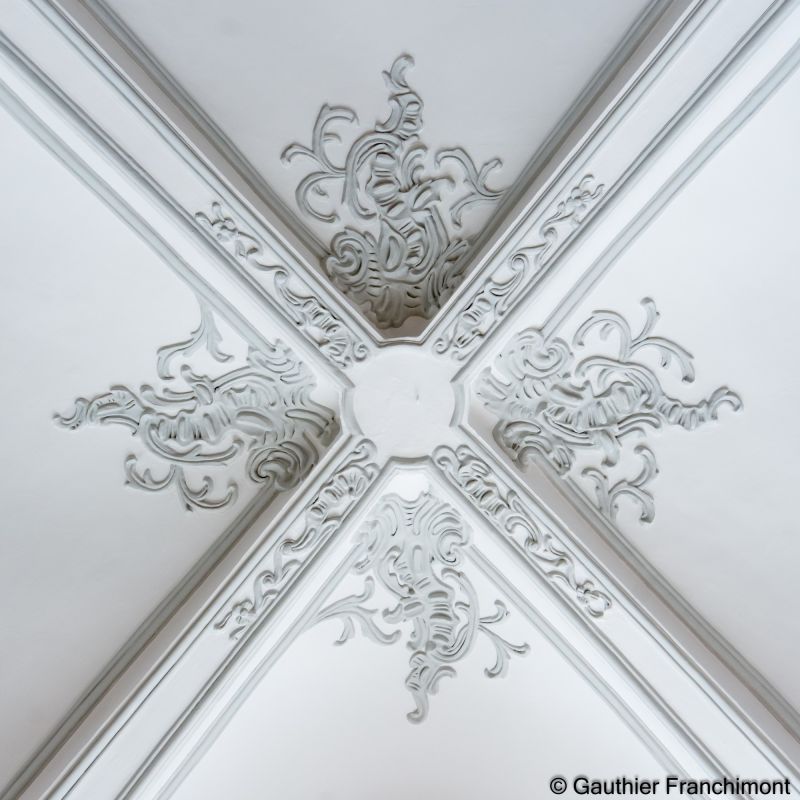
As fragile and delicate art heritage, stuccoes were often applied in the decorative art of the church in Clermont. The ceilings of the central nave and the northern and southern aisles are covered in extensive stuccoes, with as its main characteristic the great diversity in foliage, festoons, and volutes. The recent prestigious restoration of the church naves strongly highlights these essential decorative elements.