Saint Gilles
rue d'Hesdin
62770 Blangy-sur-Ternoise
Church | | Neoclassical | Catholic Church


Map
Opening hours
Description
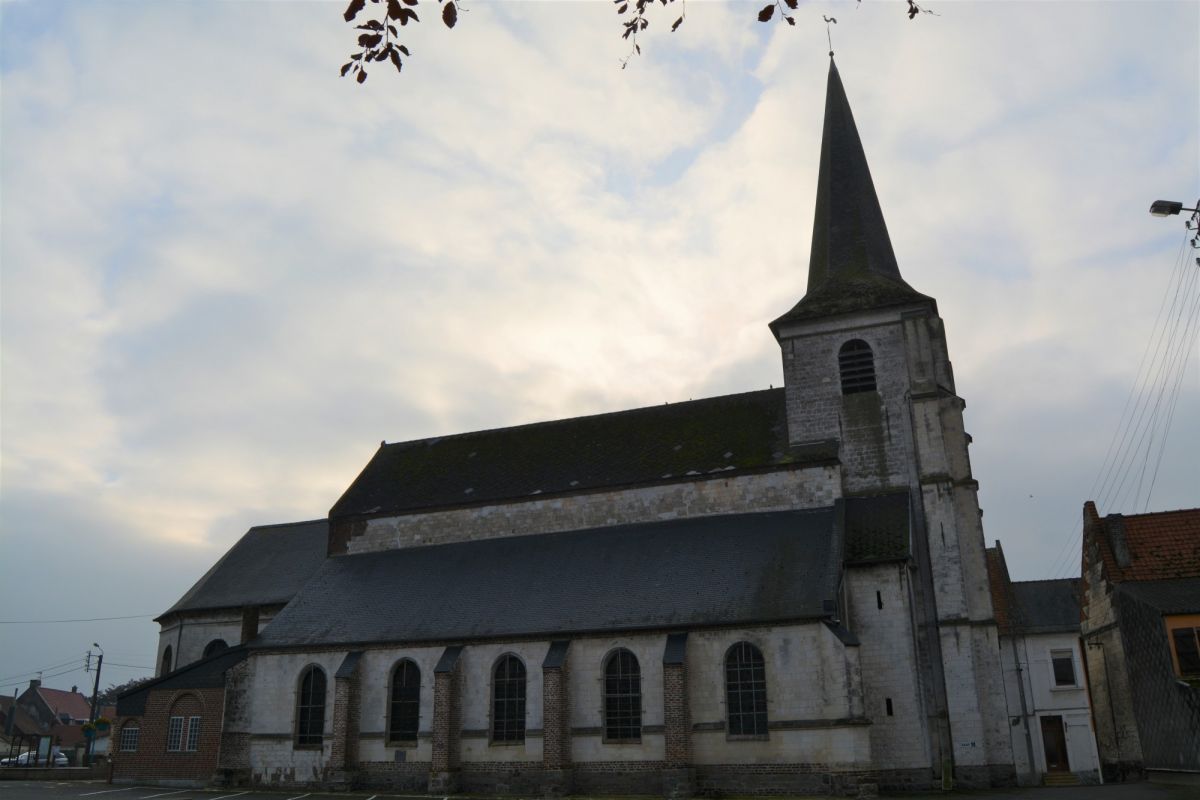
In the 7th century, Blangy-sur-Ternoise (Blangiacium) became, by the will of King Clovis II, a county and one of the seven fortresses of the Ternois region. Its development is linked in particular to a figure who became the identity of the commune: Saint Berthe. In 682, on the death of her husband, she transformed her castle into an abbey to accommodate Benedictine nuns. This first abbey was destroyed during the Norman invasions two centuries later, then rebuilt in the 11th century by Benedictine monks.
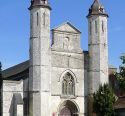
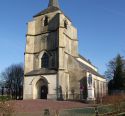
In 1537, Charles V's troops set fire to the parish church, which had been built ‘backwards’. It was not restored until the 18th century, at the behest of the monks of the abbey, in a neoclassical style, with the choir facing east. The French Revolution destroyed most of the abbey buildings, and the current abbey occupies the site of the former farm.
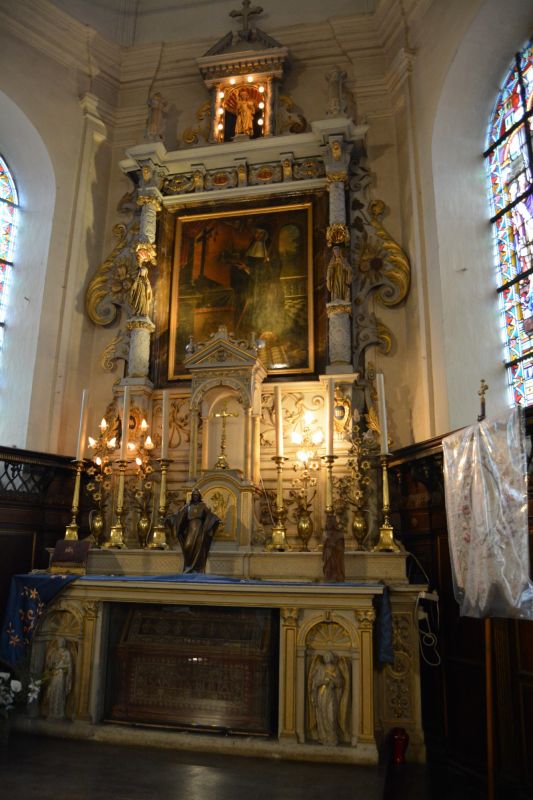
Although dedicated to Saint Gilles, this church is also dedicated to Saint Berthe, who is depicted in the altarpiece painting above the high altar, in the stained glass windows of the choir, and above all in the shrine containing her relics. The Novena organised in July to celebrate Saint Berthe's feast day is a must-see event in the region.
As you stroll through this village, which has been designated a Heritage Village since 2021, you will discover other places linked to Saint Bertha.
Translated with www.DeepL.com/Translator (free version)

Photos
Remarkable elements
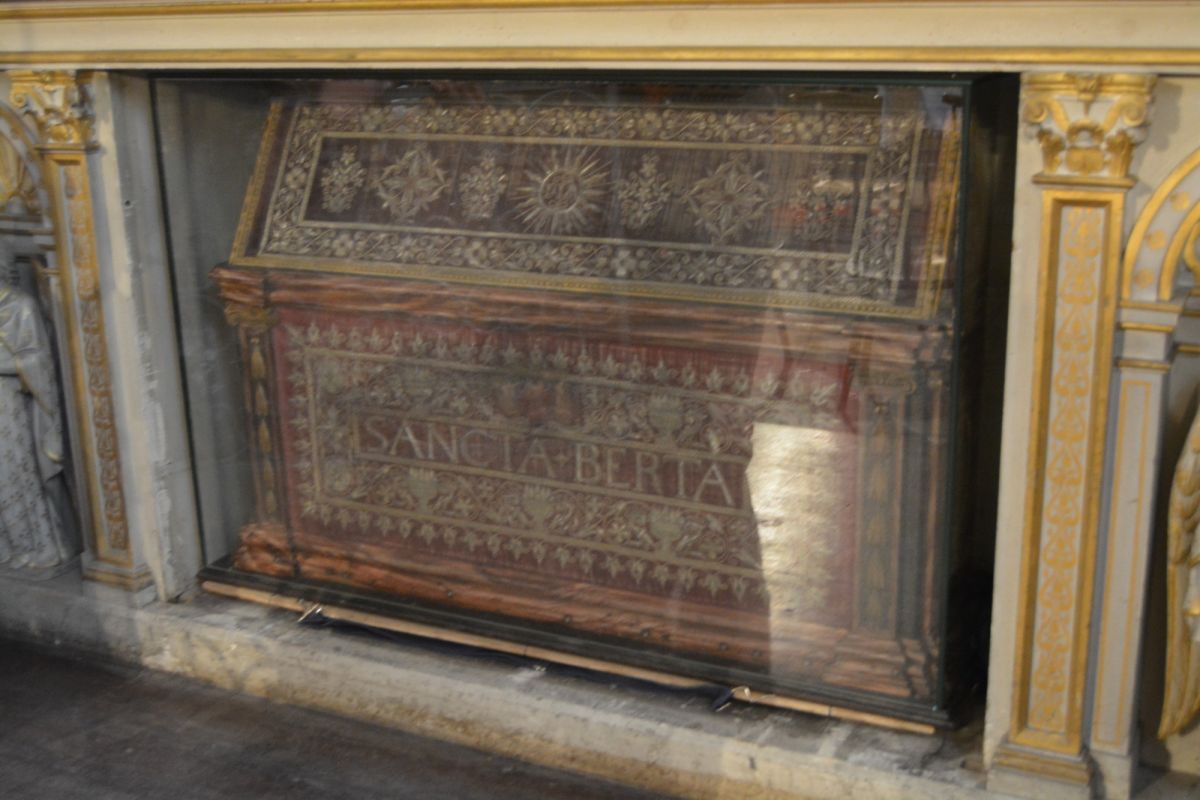
The reliquary of St. Berte
This carved oak reliquary was installed in 1606 by Abbot Baudouin Lallemand. Shaped like a chest and with a roofed lid, it preserves the remains of the body of Saint Berthe, founder of the abbey - which bears her name - located a few streets from the church. Decorated with gold thread embroidery on red velvet in 1627, it bears the inscription "Sancta Berta" and "Ora Pro Nobis" on each long side, as well as the portrait of Saint Barbara and that of an abbot on the sides.
Translated with www.DeepL.com/Translator (free version)
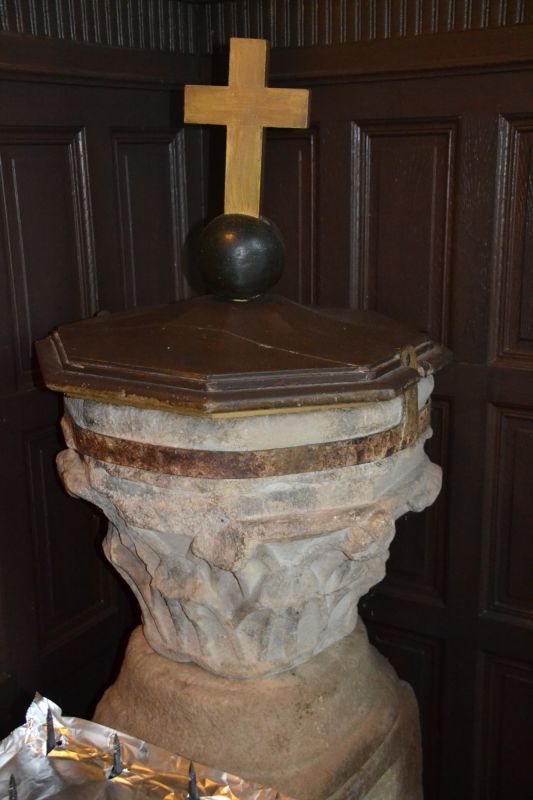
The baptismal font
They consist of two parts: the octagonal bowl sculpted with geometric motifs and the square base on which are represented the arms of Abbot Leurin (a fretted coat of arms surmounted by an abbot's crook and a cross), the first mitred abbot of Blangy at the end of the 16th century. On the other sides are an inscription indicating "Pierre Leurin, abbot", the date "1590" and a circle, symbol of eternity.
Translated with www.DeepL.com/Translator (free version)
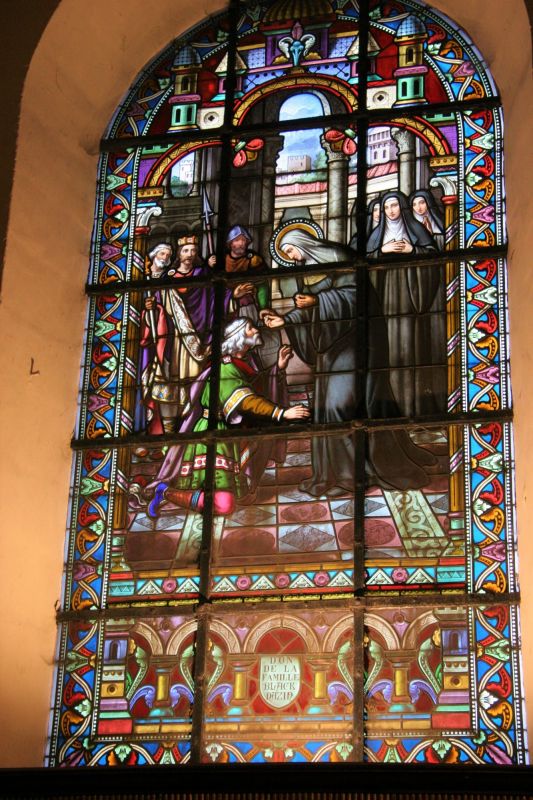
The stained glass windows
In 1846, Abbot Laisné decided to modernise the church's stained glass windows and thus give them a uniform character. The first stained glass windows were installed a few years later, following the same round arch architecture. The four windows in the choir depict St. Francis of Assisi as a full-length figure, St. Gilles as an abbot and two scenes from the life of St. Berthe.
Translated with www.DeepL.com/Translator (free version)
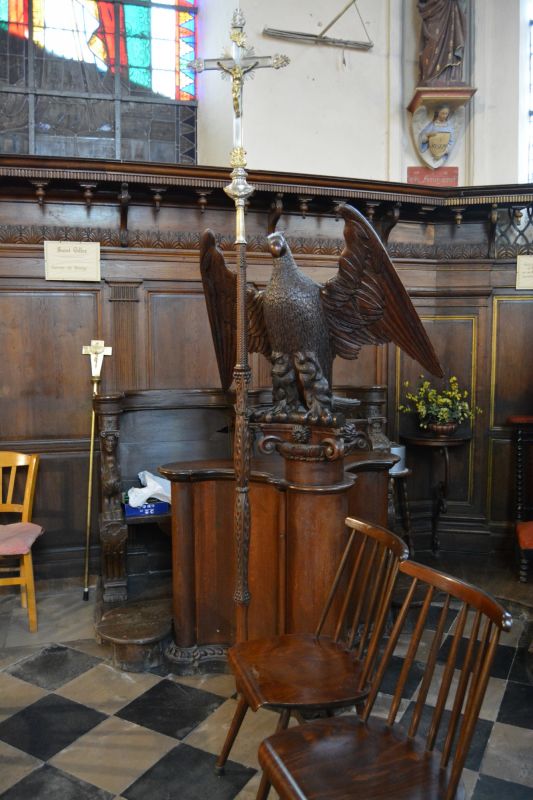
The lectern
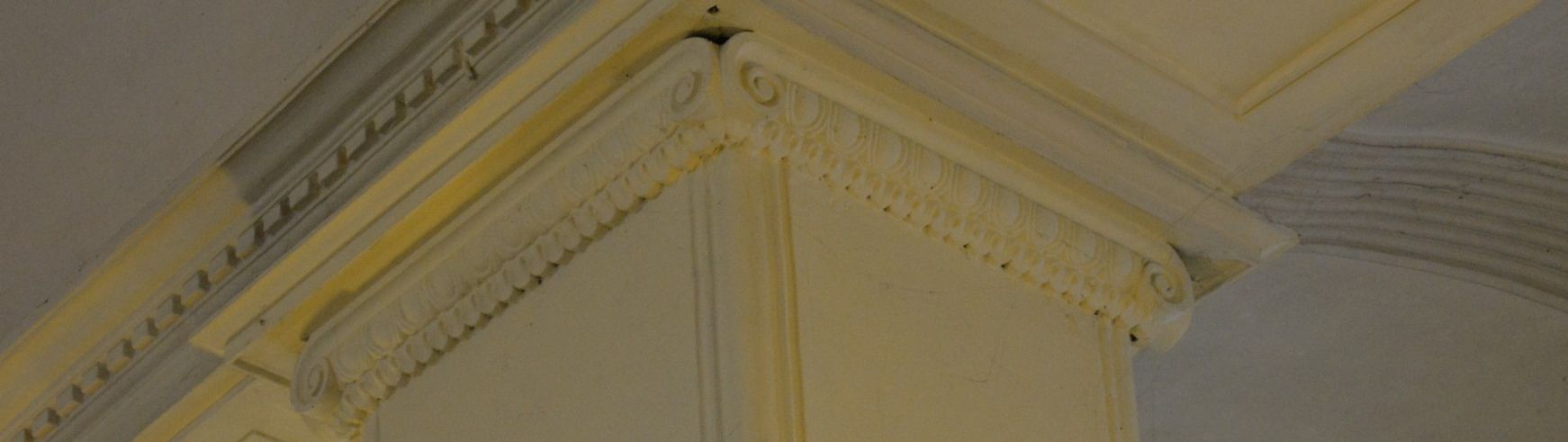
The eagle is a symbol of Saint John the Evangelist, but also an emblem of strength and majesty. Thanks to its wings, the eagle can also be used to hold large books during the reading of the Word. This one comes from an old lectern, it holds a processional cross on its right wing and rests on a first square base with Ionic decoration, itself placed on a table with curved sides.
Translated with www.DeepL.com/Translator (free version)
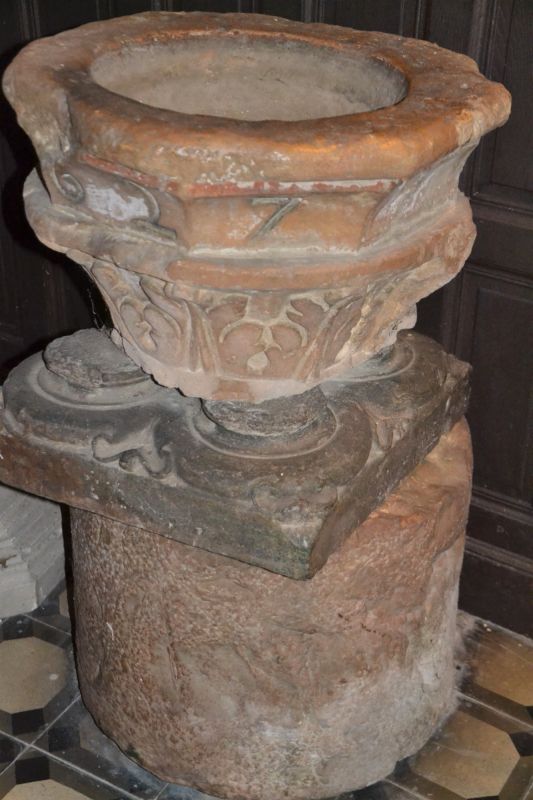
The stoup
This octagonal piece of furniture is said to be sandstone from the tomb of Saint Omer, enriched with sculpture. Its base is said to come from an old blue marble column.
Translated with www.DeepL.com/Translator (free version)
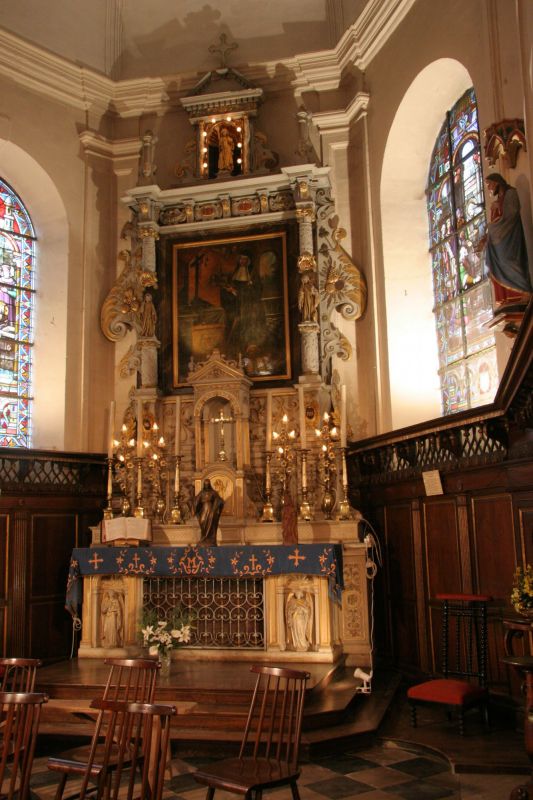
The high altar
Built in the Flemish Renaissance style, it is thought to date from 1630. At the bottom, two angels surround the shrine of Saint Bertha. On the tabernacle, Christ is depicted as the Good Shepherd. The impressive altarpiece consists of a painting of Saint Bertha in prayer presenting a model of an abbey in the centre, with three statuettes completing the decoration: Saint Bertha's daughters (Saints Gertrude and Deotile) surround the painting.
Translated with www.DeepL.com/Translator (free version)