
Saint Peter
Brugsestraat 1
8020 Oostkamp
Church | 1175 | Romanesque, Gothic, Neoclassical | Catholic Church


Map
Opening hours
01 April - 31 October
Mon 8.00 - 19.00
Tue 8.00 - 19.00
Wed 8.00 - 19.00
Thu 8.00 - 19.00
Fri 8.00 - 19.00
Sat 8.00 - 19.00
Sun 8.00 - 19.00
01 November - 31 March
Mon 8.30 - 18.00
Tue 8.30 - 18.00
Wed 8.30 - 18.00
Thu 8.30 - 18.00
Fri 8.30 - 18.00
Sat 8.30 - 18.00
Sun 8.30 - 18.00
Religious offices
Description
During the religious wars in the late 16th century, the church was severely damaged and was even temporarily used to house the pastor and local residents. The restorations began in the 17th century, in which the church was restored to its original function.
Through the ages, numerous renovations and additions were done. The most recent and most striking addition was the relocation of the altar to a stage under the tower, during which some historical graves and inscriptions were discovered.
The church consists of many interesting works of art and valuable items, such as the 32 stained glass windows with depictions of Saints, and two large stained glass pieces referring to the victims of World War I and Our Lady of Lourdes. There are also important pieces like a 15th century statue of Mary, a wooden communion bench from 1718, old confessionals, and paintings by Jan Maes and Jan Garemijn.
In addition, the church houses two notable pipe organs: the Van Eynde Organ from 1717, which has been classified and restored, and the modern Pels organ from 2018 which is located in the high choir. The yearly organ concerts in August draw visitors to the church from far and wide.
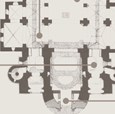
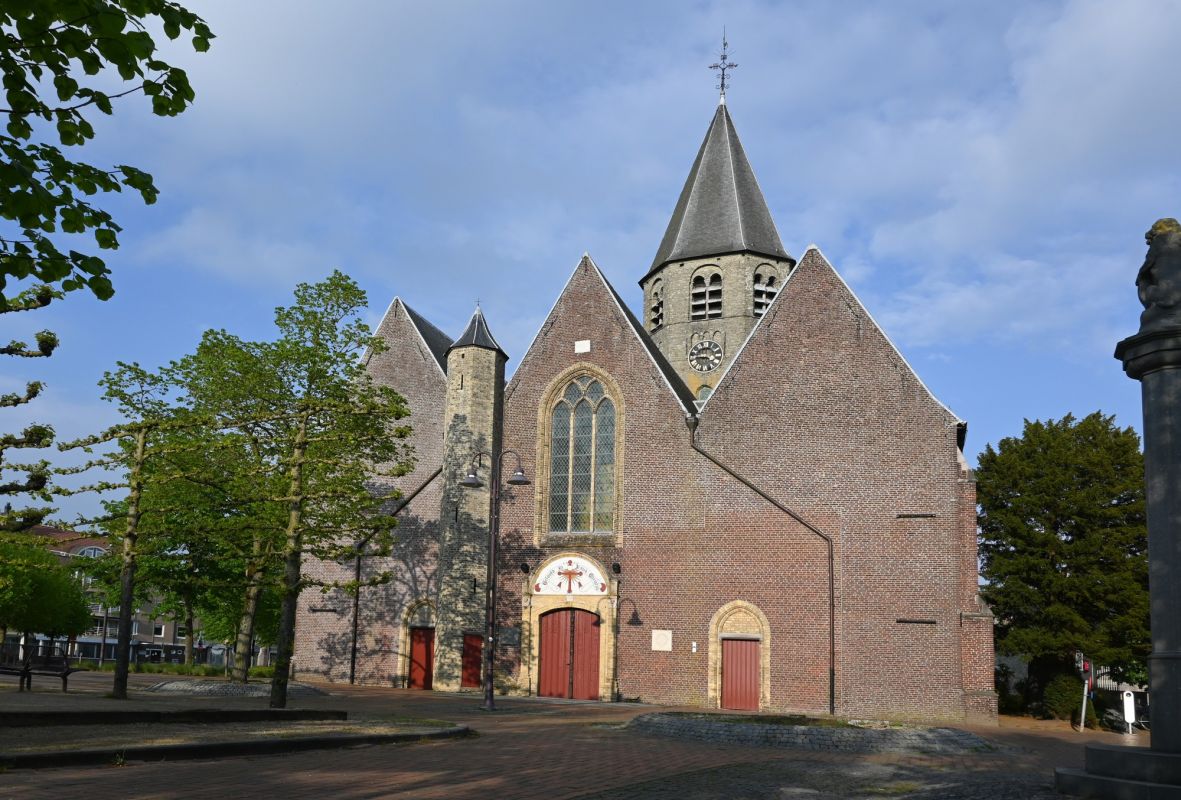
On the church exterior, there are some walled in gravestones, and on the northside there is a lapidarium that reminds one of the old, now vacated cemetery. The original contours of the medieval cruciform church are still visible in the western facade, which gives a remarkable look on the architectural history of the building.
KIKIRPA: Photo-library online

Photos




Remarkable elements
Stained glass window Laudato Si
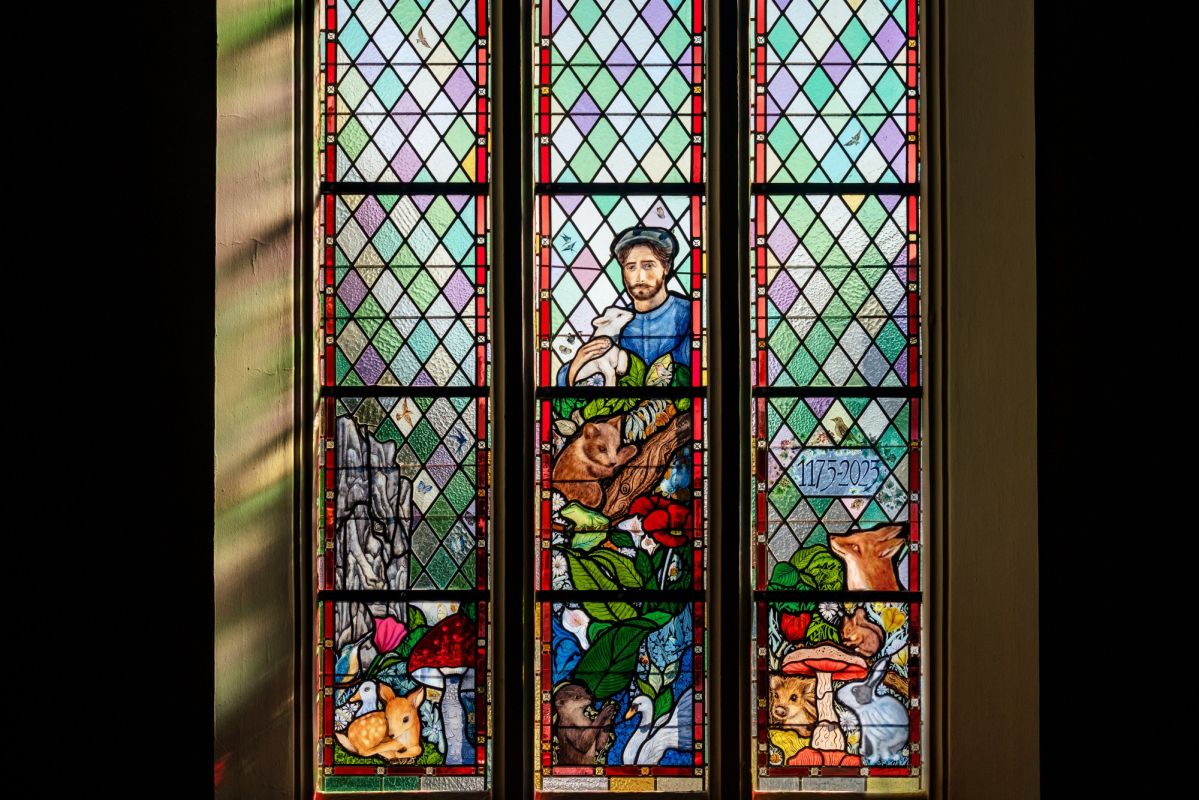
This window, dedicated to Francis of Assisi, enriches the church interior and invites us to look at creation with renewed attention. Laudato Si reminds us of our responsibility for the earth and emphasises care for people, nature and our common home. The new stained-glass window is a contemporary addition to the 15 existing stained-glass windows from the 19th and 20th centuries that adorn our church.

Statue of Our Lady (around 1400)
Restored to mark the 850th anniversary of St. Peter's Church, this polychrome wooden statue of the Madonna and Child (approx. 68 cm) probably dates from the late 14th or early 15th century. The graceful Madonna, the fine folds and the craftsmanship are striking. Originally, the statue was also decorated with so-called cabochons, smooth-cut colourful gemstones without facets, often round or oval in shape. It is the oldest piece of heritage in the church.

Communion rail (1718)
The communion rail made by Michiel Clauwaert from Bruges, originally with 4 fixed panels and 3 doors, was extended in 1865 by J. Van Nieuwenhuyse with 4 parts to its current width of 20.26 meters. One can see scenes from the Old and New Testament on the sculpted panels and reliefs with from left to right: Saint John the Evangelist, Madonna and Child, Saint Luke the Evangelist, the Adoration of the Mystic Lamb, a chalice with Communion Wafer surrounded by cherub’s heads, the Liberation of Saint Peter, the consecrated bread and wine with God’s All-Seeing Eye and cherub’s heads, the Ark of the Covenant, Saint Mark, Saint Ursula, and Saint Matthew the Apostle. The most recent panels depict the Four Evangelists John, Luke, Mark, and Matthew.

Confessionals (1663)
The Bruges master carpenter Rycquaert Brouckman made this oak confessional in Renaissance style for 53 pounds. Four columns divide the three spaces, covered by a decorative crown molding. The classical composite columns are decorated at the bottom with fantasy birds, leaves, and child figures. The elegant frieze with leaf curls, angels, dolphins, and human faces reminds one of the confessionals in the Saint Stephen’s church in Ghent, but in simplified form. The crowing element is missing in the saint niche. In 2017, all the confessionals were restored by Richardson-Weissenborn from Bruges.

Van Eynde organ (1717)
Jacobus van Eynde built this organ in 1717 for 1300 guilders to replace the older instrument from 1665. It has a beautifully sculpted baroque organ case, decorated with angels, vases, and trophies. One can find the date in two oval cartouches above the cross motif.
Important maintenance took place in 1749, 1827, 1857, and 1870. In 1924, it was converted into a pneumatic action by Jules Anneessens. In 1992-93, it was reconstructed in its original style by Verschueren organ construction.
Since 1980, the organ became a protected monument and now belongs to the oldest still played organs in Flanders. Since 1994, annual organ concerts have been organized every August.

Painting “Christ handing the keys of Heaven to the Apostle Peter” (1658)
The painting by the Bruges painter Jan Maes (? - 1677) depicts Christ handing the keys of the Church to the kneeling Peter. Until the end of the 19th century, it hung above the main altar.
During the restoration in 1768, one discovered another painting underneath the paint : the Adoration of the Shepherds. Elements from the original composition remain visible: a character sitting in the foreground and apostles that look like shepherds. The lines of sight suggest that Maes turned an unfinished Adoration into Christ handing the keys to the Apostle Peter.