
St. Lawrence
rue de l'Eglise
59310 Aix-en-Pévèle
Church | X | Romanesque | Catholic Church


Map
Opening hours
01 April - 31 August
Mon 10.00 - 18.00
Tue 10.00 - 18.00
Wed 10.00 - 18.00
Thu 10.00 - 18.00
Fri 10.00 - 18.00
Sat 10.00 - 18.00
Sun 10.00 - 18.00
01 September - 31 October
Mon 10.00 - 16.00
Tue 10.00 - 16.00
Wed 10.00 - 16.00
Thu 10.00 - 16.00
Fri 10.00 - 16.00
Sat 10.00 - 16.00
Sun 10.00 - 16.00
Religious offices
Description
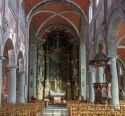
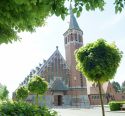
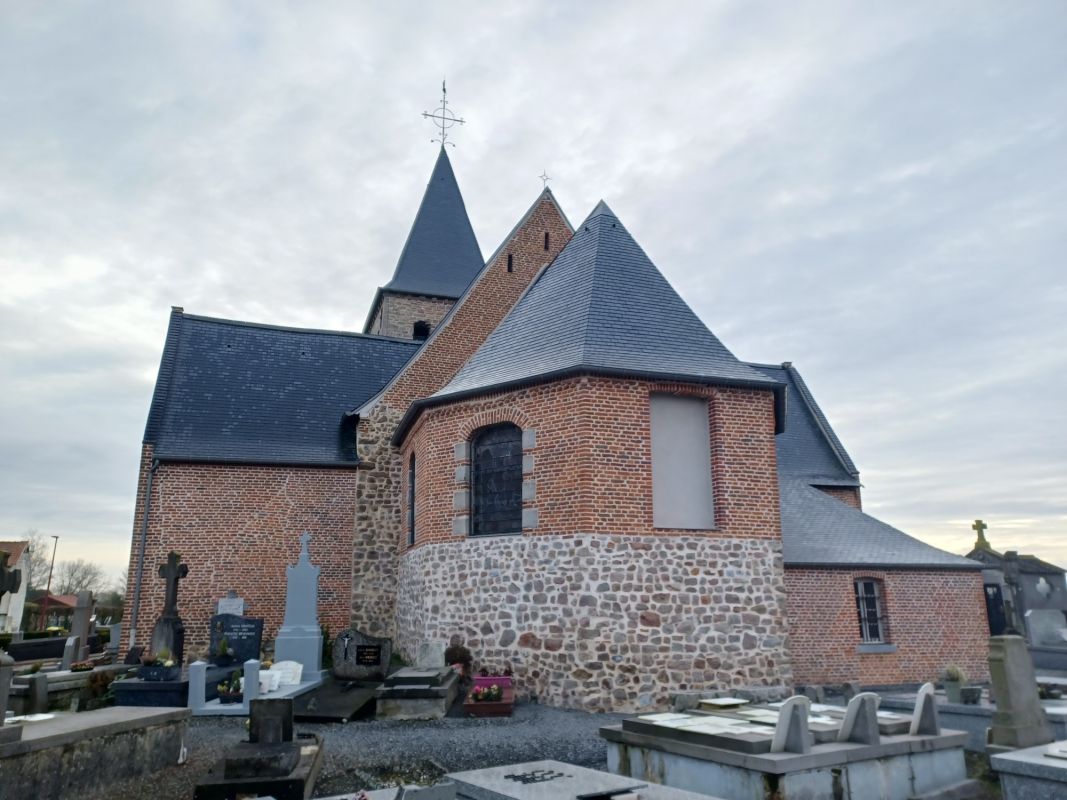
It is undoubtedly one of the oldest churches in Pévèle. Built around the 10th century, as evidenced by its bell tower typical of the Carolingian period, a massive square bell tower made of sandstone and Roman tiles, which rises to three floors.
During its history, the church has been reversed: the old choir is now under the current porch. A hidden relic probably bears witness to this period under the staircase leading to the gallery: an ancient bas-relief bearing the arms of the Chastel de la Howarderie family, who were long-time owners of the seigneury of Aix.
Over the centuries, the church has undergone several renovations. In 1835, the side walls were rebuilt, the windows lengthened and the side walls raised. The building was completely restored by the municipality in 2017, under the direction of François Bisman, a heritage architect.
Despite all the changes it has undergone, the church of Aix-en-Pévèle still welcomes parishioners who knelt in the same nave nearly a thousand years ago.
Translated with www.DeepL.com/Translator (free version)
Photos





Remarkable elements

The mounted canvas of Our Lady of the Assumption
The left side altar features a mounted canvas (undated and unsigned) depicting the Assumption of the Virgin Mary rising from her tomb in a radiant and luminous cloud. Supported by two angels, she is surrounded by angel musicians. Around her tomb, the apostles pray as witnesses to the miracle. Saint Peter can be recognised in the foreground on the right.
This canvas is framed by false columns, remnants of the church's former décor.
Translated with www.DeepL.com/Translator (free version)

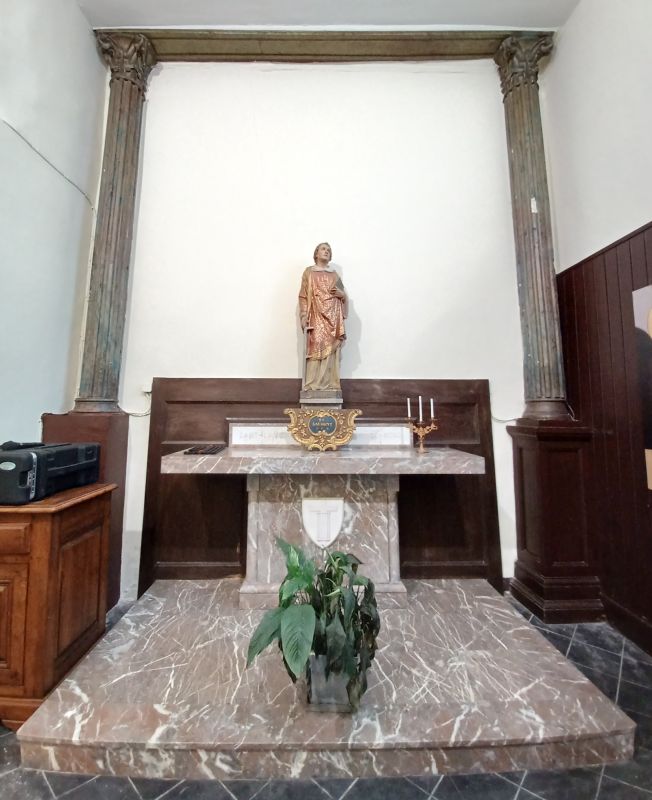
The altar dedicated to Saint Thérèse
The altar dedicated to Saint Thérèse of Lisieux is a fine example of Art Deco religious furniture. The side panels of the altar are decorated with very linear floral motifs: roses for Saint Thérèse and lilies, attributed to the Virgin Mary for their purity. In the centre, the escutcheon decorated with a cross surrounded by three stars represents the coat of arms of the Carmelite Order.
Translated with www.DeepL.com/Translator (free version)

The war memorial
Located inside the church, this monument was erected in recognition of the ‘children of the parish of Aix-lez-Orchies who died for France’. It depicts a soldier leaning against the stele and looking up at the sky. He is accompanied by an angel presenting him with a laurel wreath, a symbol of triumph, glory and victory.
Translated with www.DeepL.com/Translator (free version)

The statue of Saint Lawrence
Saint Lawrence is depicted with the grill, symbol of his martyrdom. The drape of the cloak retains traces of golden and purple polychromy, applied with a stencil and specific to the production of statues in the Saint Sulpician style. The decoration is reminiscent of that of the other statues and the Stations of the Cross, suggesting that all the decorative furnishings were renewed at the end of the 19th century or the beginning of the 20th century.
Translated with www.DeepL.com/Translator (free version)

The Virgin and Child, ceramic
This is a work by artist Boleslaw Danikowski (1928–1979), who is buried in the local cemetery. Made of beige, almost white glazed ceramic, it consists of a halo resembling a radiant sun, in front of which the faces of Christ and his mother are depicted in profile. This naive representation is very gentle and conveys the infinite tenderness between the two figures, who seem to be embracing and sharing the same heart.
Translated with www.DeepL.com/Translator (free version)

The stained glass windows in the choir
The stained glass window on the left depicts the apparition of the Virgin Mary to Bernadette Soubirous in the grotto of Lourdes. Opposite, the scene depicts the episode of devotion to the Sacred Heart of Jesus by Saint Margaret Mary Alacoque in Paray-le-Monial in the 17th century. These two stained glass windows were created by Ernest Haussaire, a stained glass artist in Lille in the early 20th century.
Translated with www.DeepL.com/Translator (free version)