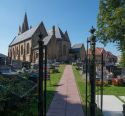

Saint Martin
Tempeliersstraat
8972 Roesbrugge (Poperinge)
Church | 1806 | Neoclassical | Catholic Church


Map
Opening hours
01 January - 31 December
Mon
Tue
Wed
Thu
Fri
Sat
Sun 10.30 - 11.30
The church is open on the 1st, 2nd and 4th Sunday of each month.
Religious offices
Description
Roesbrugge already had a chapel in the 13th century, first served by the Norbertines of Beauregard, later by the Discalced Carmelites of Ypres, and eventually by a chaplain. Baptisms, marriages, and funerals were not allowed there.
Over the centuries, the chapel and the village suffered repeated fires, plundering, and destruction, yet each time they were rebuilt. On September 18, 1793, French revolutionary troops under General Vandamme burned the entire village and its large chapel.
After the suppression of the Ypres diocese in 1801, Roesbrugge became part of the Ghent diocese, which authorized the construction of a parish church. In 1805, the bishop asked all pastors of the Ypres region to collect funds. The nave was built in 1805–1806 and consecrated by Rev. Vermeersch on September 9, 1806. The church was dedicated to Saint Victor. In February 1807, Roesbrugge became an independent parish with Rev. Joannes Josephus Reyhins as its first pastor.
The church, initially a single nave building without a tower, remained unfinished until 1826. With state and provincial support, the tower and aisles were added, and construction ended in 1838. Meanwhile, the church was renamed St. Martin’s, after the suppression of St. Martin’s parish in nearby Haringe in 1807. When Haringe regained parish status in 1835, both villages had a St. Martin’s parish.
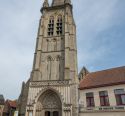
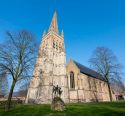
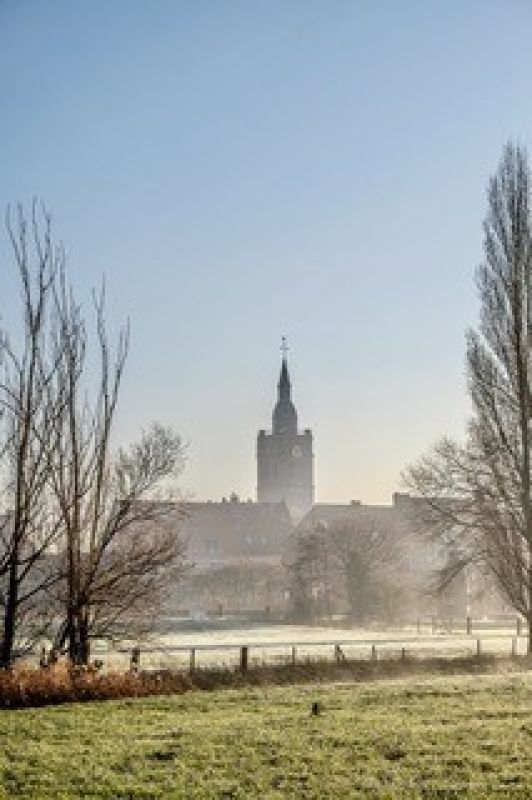
The hall church without a transept, built to replace the chapel destroyed in 1793, was further completed from 1826 onward. In 1837, it received a striking neoclassical belvedere tower designed by Ypres architect Lernould.
Photos



Remarkable elements

Chandelier
The oak chandelier, 1.8 meters in diameter, 3.4 meters in height, weighing 420 kilograms. Sculpted by J.F. Michiels from Bruges. Partially destroyed by a bomb in May 1940, and restored by Jozef Deschuyter in 1975.

Pillars
The bluestone columns were made from a single stone (remarkable) from the Carrières du Hainaut quarry. They were transported by horse-drawn wagons. For this, the road that passes through Couthof forest from Poperinge to Proven had to be widened and paved with cobblestones.
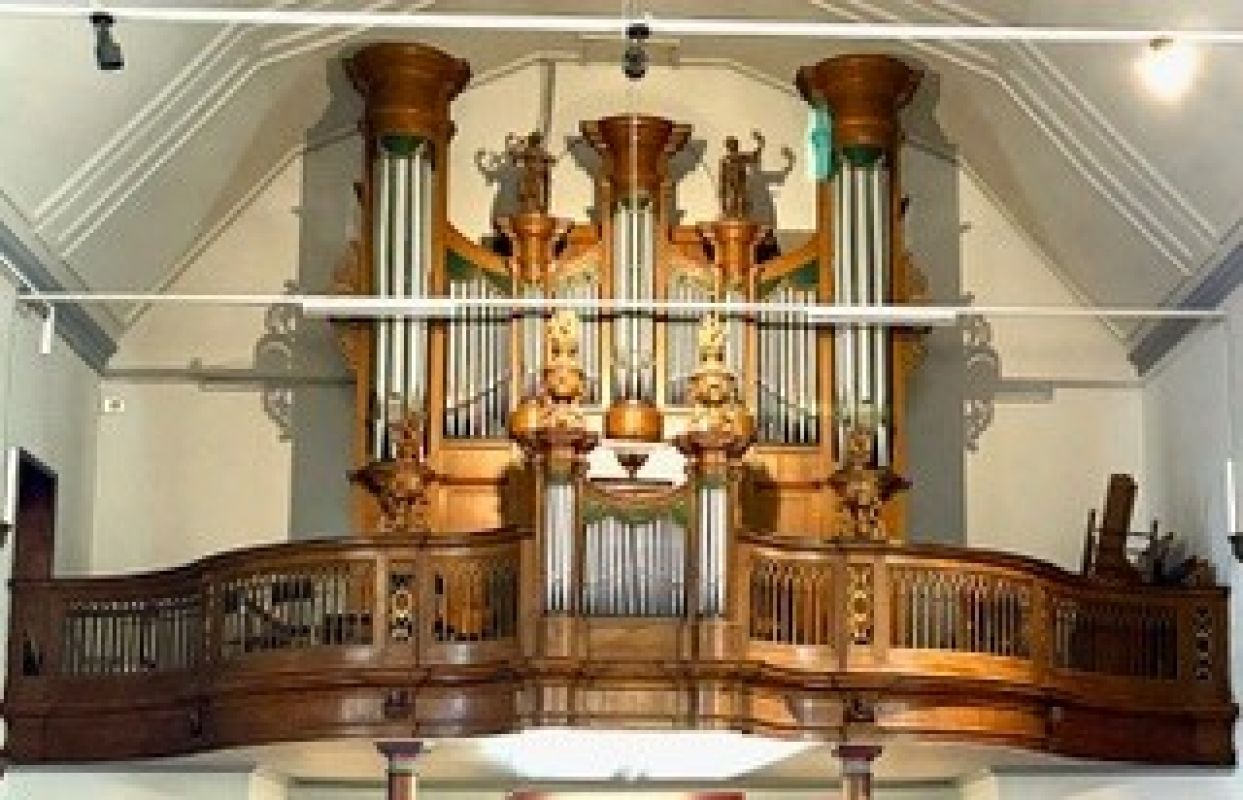
Organ
Organ from 1832-1833. Built by Pierre (Jr.) van Peteghem from Ghent. Partially destroyed by a bomb in May 1940. Complete reconstruction and enlargement by Jos, Loncke and Sons in 1957.

Banners
1. Banner of the ‘Onderlingen bystand’ (English: Mutual Assistance), which is currently the Public Centre for Social Welfare.
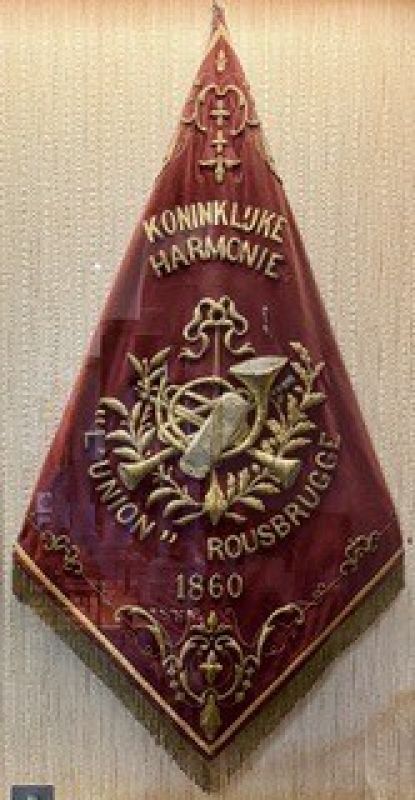
2. Banner of the Royal Concert Band
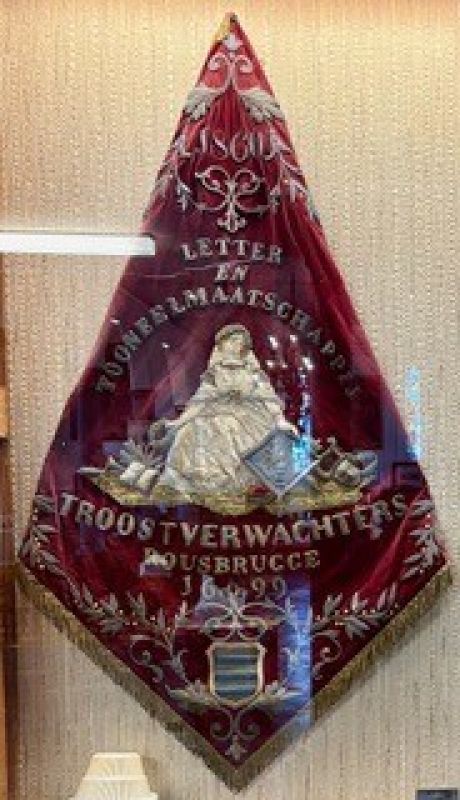
3. Banner of the theatre company ‘De Troostverwachters’(English: The Comfort Expectants).
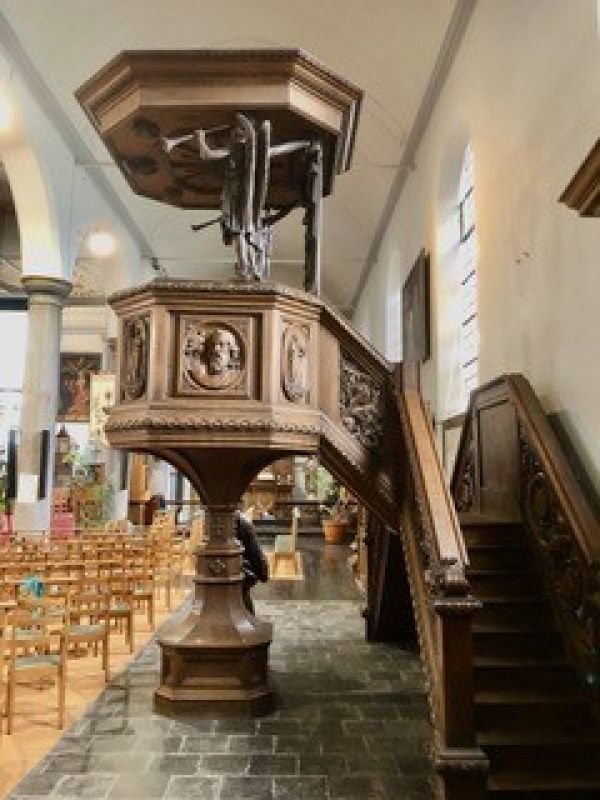
Pulpit
Late 18th century pulpit with a statue of Saint Peter under the tub, and on the panels depictions of Saint John the Evangelist and the three theological virtues: Faith, Hope, and Love. Made by J.F. Michiels from Bruges.

Confessionals
In the left aisle: 17th-century confessional. In the right aisle: two neo-Gothic confessionals from the 19th century.