
Saint Ranulf
Place du Maréchal Leclerc
62580 Thélus
Church | 1930 | Neogothic | Catholic Church


Map
Opening hours
01 October - 31 March
Mon
Tue
Wed
Thu
Fri
Sat 10.00 - 12.00
Sun 10.00 - 12.00
01 April - 30 September
Mon
Tue
Wed
Thu
Fri 10.00 - 18.00
Sat 10.00 - 18.00
Sun 10.00 - 18.00
Guided tour
Religious offices
Description
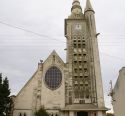
The village centre comes into view after a long street lined with a few old farms, leading to the central square dominated by the church tower. Dedicated to Saint Ranulphe, evangeliser of the Artois countryside and martyr of the 8th century, the church is located at the end of an alleyway where tradition has it that there was once an underground passage leading to Saint-Vaast Abbey in Arras. Upon entering the church, the memory lives on with photos on display of the old church, destroyed during the fighting in 1917. These images are accompanied by a letter written by a German officer, the author of the photograph.
The visit to the church continues with the memory of Saint Ranulphe and his son Hadulphe - one of the first bishops of Arras - with the reliquary of Augustin Lefebvre containing a phalanx of Ranulphe and a vertebra of Hadulphe.
This 1930s church is strongly influenced by Art Deco in its liturgical layout. The confessional, high altar and chandelier in the choir comply with the codes of this new artistic movement.
Translated with DeepL.com (free version)


Photos


Remarkable elements

Saint Ranulphe
He devoted himself to evangelising the population by travelling through the countryside of Artois. One day, he is said to have caused a spring to gush forth between the villages of Farbus and Vimy when the inhabitants refused to give him a drink.
He died in 700, martyred by the Saxons. His body was preserved in a sarcophagus that was transferred to Arras in the 12th century, then pierced to house a relic in the 19th century. All trace of it was subsequently lost, and tradition has it that it is in Roclincourt.
Translated with DeepL.com (free version)

Photo collection
Every year, the church displays numerous photos depicting the community before, during and after the First World War. This is also an opportunity to discover the ‘viewpoint’ trail that crosses the village to Vimy Ridge and its memorial site.
Currently being restored.
Translated with www.DeepL.com/Translator (free version)

Reliquaries (early 20th century)
Carved from wood, these are the work of Augustin Lefebvre, a local craftsman. These reliquaries are shaped like small houses with arched openings and floral decorations. The reliquary of Saint Ranulphe (letters S and R above the central opening) is said to contain a phalanx. The second, associated with Hadulphe, is said to contain a vertebra. The decoration on the cushions on which the relics are placed is representative of Art Deco, which was in vogue between the two world wars.
Translated with www.DeepL.com/Translator (free version)

Stained glass windows
In the aftermath of the First World War, churches were rebuilt thanks to donations from families. Among the saints represented in the parish, one has been forgotten: Camillus. An Italian priest in the 16th century, he founded the Camillian order in Rome to assist the wounded on the battlefield, whom they identified with a red cross. Three centuries later, Henry Dunant would take up this symbolism in the creation of the International Red Cross after the Battle of Solferino.
Translated with www.DeepL.com/Translator (free version)

Art Deco furniture
The interwar period saw a revival of sacred art, bringing contemporary art into churches through a new artistic movement: Art Deco. Liturgical furniture used the general codes of this style: geometric shapes and simplicity in decoration.
The high altar, confessional, side altars, reliquaries and choir chandelier are perfect examples of the development of this artistic style in the provinces.
Translated with www.DeepL.com/Translator (free version)
Übersetzt mit www.DeepL.com/Translator (kostenlose Version)

Commemorative stones
Both embedded in the back of the high altar, the first stone commemorates the construction of the choir of the old church in 1733 by Cardinal de Rohan, abbot of Saint-Vaast d'Arras and Lord of Gouves, Grand Bailiff of the Abbey and deputy of the States of Artois. The second commemorates the laying of the foundation stone during the reconstruction in 1929 in the presence of Monsignor Guillement.
Translated with www.DeepL.com/Translator (free version)