
Saint-Martin de Tours
Place Saint-Méen
44850 Le Cellier
Church | XIX-XXe | Neoromanesque | Catholic Church


Map
Opening hours
01 November - 30 April
Mon 9.00 - 18.00
Tue 9.00 - 18.00
Wed 9.00 - 18.00
Thu 9.00 - 18.00
Fri 9.00 - 18.00
Sat 9.00 - 18.00
Sun 9.00 - 18.00
01 May - 31 October
Mon 9.00 - 19.00
Tue 9.00 - 19.00
Wed 9.00 - 19.00
Thu 9.00 - 19.00
Fri 9.00 - 19.00
Sat 9.00 - 19.00
Sun 9.00 - 19.00
Guided tour
+33 6 86 44 25 92 • passerelle.cd@gmail.com
Religious offices
Description
In the 19th century, the site was developed and a new, larger church was built from 1896 onwards. The church of Saint Martin replaced an earlier church dating from the 15th to 16th centuries. The Romanesque-Byzantine plans were designed by the architect René-Michel Ménard, who was unable to carry out the work. The work was entrusted to architects Lagaury and Libaudière. Due to a lack of funds, the work had to be interrupted and was not resumed until after the First World War.
Recently restored, the church still dominates the landscape and is easily recognisable thanks to its schist stone, typical of the region. It is now listed as a Historic Monument.


Photos


Remarkable elements

Sculpture by Jean Mazuet
Sculpture by Jean Mazuet This descent from the cross is the work of Nantes sculptor Jean Mazuet (1908-1984). It was created during the Second World War. At the foot of the scene, a Latin inscription reads ‘O you who pass by here, stop and see if there is any pain comparable to mine’.

The Risen Christ
Protected as a Historic Monument, this 18th-century polychrome wooden statue depicts the risen Christ, dressed in his shroud. His right hand is raised in blessing, while he holds a cross in his other hand. In traditional representations, Christ often carries the standard of the Resurrection: a white banner with a red cross, symbolising his victory over death.

The dream of Saint Martin
This high relief depicts Saint Martin as a soldier, asleep at the foot of a fortress. Above him appear Christ and angels. This scene illustrates the dream that follows the episode of Charity, where in Amiens he shared his military cloak with a beggar. The following night, Christ appeared to him wearing the cloak, evoking the Gospel according to Saint Matthew: ‘Whatever you did for one of the least of these brothers and sisters of mine, you did for me.’

Frescoes
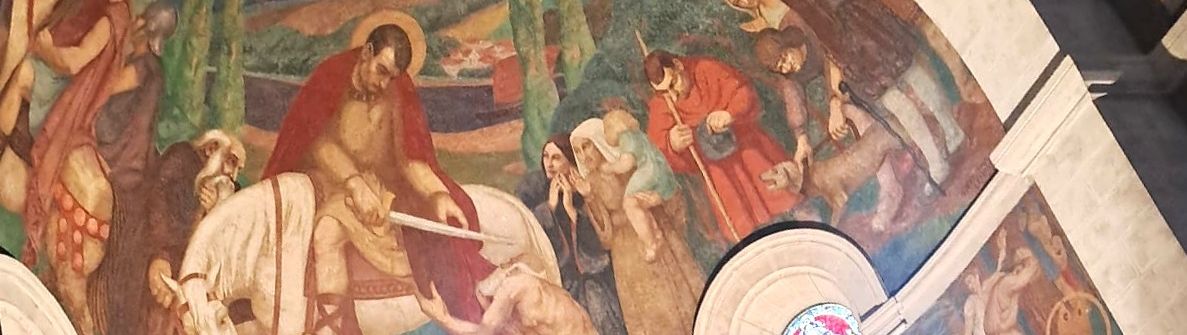
Created between 1925 and 1931, they are the work of brothers Paul and Albert Lemasson, local artists from Saint-Mars-du-Désert.
The choir is dominated by Saint Martin's Charity, which takes place not in Amiens but on the banks of the Loire. Below, four scenes recount the life of the saint: his baptism in Pavia, the resurrection of a catechumen when he was a monk in Ligugé, the healing of a leper at the gates of Paris when he was bishop of Tours, and the miracle of the felled pine tree.

Way of the Cross
This is a remarkable work of religious art from the 1930s, painted by Albert Lemasson. He chose a tight framing so that the scenes could be seen up close, with the figures depicted halfway up the body. Most of the images are square, to create a strong bond with the viewer. The style is expressive but softened by soft colours, such as the blue of the Virgin. Christ wears a white garment, a symbol of peace and sacrifice.

Processional banner
Dating from the first half of the 19th century, this remarkably well-preserved red velvet banner has two sides: one depicts Christ on the cross and the other Saint Martin in his bishop's habit.
Partners

