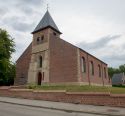
Saint Nicholas
Warandestraat 2
1770 Liedekerke
Church | 1904 | | Catholic Church


Map
Opening hours
01 January - 31 December
Mon 9.00 - 16.30
Tue 9.00 - 16.30
Wed 9.00 - 16.30
Thu 9.00 - 16.30
Fri 9.00 - 16.30
Sat 9.00 - 16.30
Sun 9.00 - 16.30
Religious offices
Description
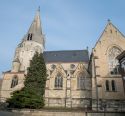
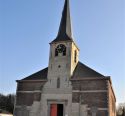
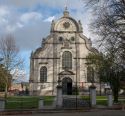
In the ninth century, the count of Flanders donated the forest "van ongenade" to Razo of Gavere, lord of Liedekerke. This well-known family built a fortified castle and probably also the first parish church. The earliest reference to the church dates from 1092. At the end of the 16th century, the church was burnt down and rebuilt. Only the tower from 1636, built in regular sandstone, was spared.
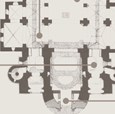
At the end of the 19th and beginning of the 20th century, the church was enlarged and fitted with a pointed steeple. Three confessionals date from 1906. The church is built in red brick.
Photos


Remarkable elements

The stained glass windows of the choir
The stained glass windows in the choir date from 1903 and were designed by the studio of Hochreiter and Geyer, glass painters from Antwerp.
Every stained glass window depicts two scenes that refer to religious figures or are connected to the history of the municipality.

Painted glass window “The Storm”
The painted glass window in the choir loft, created in 2021 by Daan and Daniël Theys, combines thirty small panels, each painted with contour lines. Its vivid colors and dramatic style echo Chagall, while swirling shapes and a blue‑and‑yellow palette recall Van Gogh. As Saint Nicholas is the church’s patron, the window offers a symbolic evocation of his story rather than a literal depiction.

Small bell
Small bell from the former convent of the Sisters of Saint Anthony of Padua.

Way of the Cross
This series of paintings was commissioned by the church council and created by the painting department of the Academy of Fine Arts of Liedekerke.
The entire history of art served as inspiration for this Way of the Cross. Books on Christ in art have shown a wide variety in approach, context, vision, authenticity, and representation.
For the depiction of the various stations, a great diversity was chosen in every respect, while maintaining a unified format and presentation.

The organ
It was built in 1907 by S. Van Bever, one of the renowned Flemish organ builders. Like his brother Adrien, he trained under Hippolyte Loret in Laeken and worked briefly in Cavaillé-Coll’s Paris workshop. It is a Romantic-style church organ, featuring two manuals, an independent pedalboard and 17 stops. This style aims to produce a warm, orchestral sound, rich timbres and a wide dynamic.