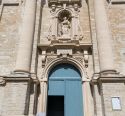
Saint Francis de Sales
Mijlstraat 108
2570 Mijlstraat (Duffel)
Church | 1903 | Neogothic | Catholic Church


Map
Opening hours
01 January - 31 December
Mon 9.00 - 11.00
Tue
Wed 9.00 - 11.00
Thu
Fri 9.00 - 11.00
Sat
Sun
Every Monday, Wednesday, and Friday from 9 a.m. to 11 a.m. We open with a moment of meditation from 9 a.m. to 9:20 a.m. Afterwards, there is an opportunity to meet, chat, and have coffee.
Every last Friday of the month: open from 7.30 pm to 10.00 pm
Every first Sunday of the month: open from 11.00 am to 12.00 pm
Religious offices
Description
The Mijlstraat parish was officially recognized on April 23, 1894, with Saint Francis de Sales as its patron. Local fundraising led to a temporary church, and in 1898 architects Edward Careels and Van de Sande designed the new building, completed in 1903 and consecrated in 1904. The neo Gothic brick church still stands as a symbol of 19th century growth.
After its consecration, the church received new furnishings. In 1904, Jan Gerrits created the high altar and two side altars. A pulpit (later turned into an altar), confessionals, and a communion rail followed. A Stevens organ was added in 1906, and Charles Beyaert’s Stations of the Cross in 1908. War damage later required repairs and modernization in 1968.
Since 2019, the church has been an “open house.” Still consecrated, it is now used in contemporary ways. Mass on Holy Saturday and Christmas Eve takes place in the “Eucharist room.” The movable altar allows the podium to serve for concerts, and behind it is a meditation room used several mornings a week. The space also hosts baptisms, weddings, intimate funerals, and monthly spiritual concerts or lectures.
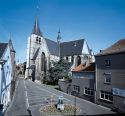
The church and rectory form the heart of the rural Mijlstraat neighborhood, surrounded by early 20th century houses, historic farmsteads, and post 1950 villas. Heritage sites include the barn at number 31, a former 1903 inn at number 296, and a 1907 house linked to the Fort of Koningshooikt. The brick church, with its slate roofs, tower, and rose window, remains a striking landmark.
Photos


Remarkable elements

The stained-glass rose window
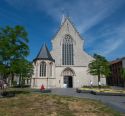
In 1903, the church was consecrated - back then still without its current weather-shielding portal. Nowadays, one must stand at a distance to admire the beautiful rose window, which is the proper term for such a window. There’s something peculiar going on at its center. Who do you think it was that wasn’t paying close enough attention at the time? Go and discover what’s not quite right about it.

The statues
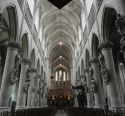
Whoever enters the church, immediately understands that there’s a new wind blowing through this building. Still, most of its classical elements were able to find a place in its new design. For example, you can still find statues of several saints, including a statue of Mary at the entrance, two Saints Anthony with different backgrounds, and a Saint Therese of Lisieux. Go and discover which caption is lying about the statue on display.

Repurposed Statues
There was a time when the most affordable way to build a new altar was to convert an oversized, already existing pulpit. While that converted pulpit has since been removed, the wood-carved statues that once adorned it have been given a prominent new home. See if you can spot these four Church Fathers: Saint Ambrose of Milan, Saint Jerome, Saint Augustine of Hippo, and Saint Gregory.

Way of the Cross 2.0
You would expect there to be fourteen stations of the Cross, but here at the Mijlstraat church’s Open House, things are done a little differently yet again. There are two stations missing. Can you figure out which ones they are? Here, you will discover how we are still perfectly capable of walking the Way of the Cross - but in a remarkably contemporary way.

Stained-glass lancet windows
Two of the three impressive stained-glass windows that adorn the wall altar did not survive the Second World War. The original window, gifted long ago, was donated by the parish’s founding pastor, and the two other windows were later commissioned by his successors. Naturally, the sunlight here shines through the patron saint of the church.

The wall Altar
Before the Second Vatican Council, Mass was celebrated at this wall, serving as a visual anchor for the service. As both the pastor and the entire congregation were facing the same direction, you can understand that they sometimes lost sight of one another. This wall altar reads like a comic book, on which you can see the four Evangelists depicted, some in their animal forms. There are also several scenes from the life of Saint Francis de Sales, the bishop who made things difficult for the Protestants.