Our Lady of the Rosary
Site de l'Éperon
61360 La Perrière (Belforêt-en-Perche)
Church | XIIe | Gothic | Catholic Church

Map
Opening hours
01 January - 31 December
Mon 10.00 - 19.00
Tue 10.00 - 19.00
Wed 10.00 - 19.00
Thu 10.00 - 19.00
Fri 10.00 - 19.00
Sat 10.00 - 19.00
Sun 10.00 - 19.00
Description
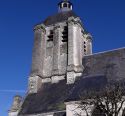
The Church of Notre-Dame-du-Rosaire preserves the memory of this past. Its bell tower stands on the foundations of a former castle tower. Built in the 12th century, it was then the castle chapel, dedicated to Saint Stephen. A few Romanesque features remain from this period, including a portal on the south façade. Enlarged and remodelled over the centuries, the church has also retained its defensive character: its fortified bell tower may have served as a refuge for the local population during times of unrest.
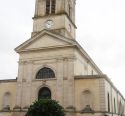
In the 19th century, La Perrière prospered thanks to the embroidered and beaded lace industry. A major restoration programme then transformed the building: the timber roof structure was replaced by brick ribbed vaults, the chapels dedicated to the Virgin Mary and Saint Joseph were fitted out, and a neo-Gothic portal was added to the west façade.
Today, the site invites visitors to enjoy a sense of tranquillity and contemplation. Extend your visit by strolling through the narrow streets of this picturesque village, where the buildings – including the church – are constructed from ‘grison’, a material that bears witness to its history: this stone, a mixture of iron-rich sandstone and sand, comes from the old local quarries that gave La Perrière its name.
Translated with DeepL.com (free version)


Photos


Remarkable elements

Statue of Saint Stephen
This statue of Saint Stephen, carved from stone and still retaining its polychrome finish, probably dates from the 16th or 17th century. It depicts the saint wearing a dalmatic, a liturgical garment traditionally associated with deacons. One striking detail catches the eye: a stone embedded in the back of his skull, a direct reference to his martyrdom, as Saint Stephen was stoned to death for his faith.
Translated with www.DeepL.com/Translator (free version)

Statue of a saint with a book
This painted and stuccoed wooden statue, dating from the 16th–17th centuries, depicts a crowned saint holding a book, a symbol of wisdom and knowledge. The absence of more specific attributes makes identification uncertain, but the work could depict Saint Catherine, often associated with books due to her erudition, or Saint Barbara, also represented as a young, noble and educated woman.
Translated with www.DeepL.com/Translator (free version)

Virgin and Child
This Virgin and Child, carved in white stone by Dominique Molknecht, a sculptor of Italian origin who became a naturalised French citizen in 1948, was donated to the parish in 1867 by Empress Eugénie, at the request of Abbé Saffrey, parish priest of La Perrière. The work is notable for the delicacy of the drapery of the Virgin's cloak, with its soft, harmonious folds. Molknecht's style, clearly inspired by ancient Greek statuary, is part of the neoclassical and academic movement.
Translated with www.DeepL.com/Translator (free version)

Stained glass window of Our Lady of the Rosary
The stained glass window of the Rosary, created in 1936 by the Lorin workshops in Chartres, is based on a design by Marthe Dano, the first woman employed by these workshops. Donated by the Guez and Dujarrier families, it depicts Saint Dominic receiving a rosary from the Virgin Mary, who is holding the Baby Jesus. The rosary features a crown of thorns, a direct reference to the Passion.
The work is notable for its skilful use of blue tones.

Gravestone
Visible in the current Saint Joseph's Chapel, it comes from the former Saint Michael's Chapel, which was renamed after the 1867 renovations. The inscription reads: ‘In the year 1602, on Wednesday, the eleventh day of December, Louis du Bouchet, squire and lord of La Monnerie during his lifetime, died: his body lies here in burial.’ The coat of arms, now hammered, bore the family arms ‘argent with three boar's heads torn from sable’.

Romanesque bay window
This Romanesque window, dating from the 12th century, is arched and has a splayed embrasure, designed to maximise interior light while maintaining the solidity of the wall. It dates from the same period as the old Romanesque south door, now bricked up, and the ground floor of the bell tower, and is one of the only visible remains of the old Saint-Étienne chapel, which once served the walled town located on the outskirts of the castle on the current site of L'Éperon.
Translated with www.DeepL.com/Translator (free version)
Partners