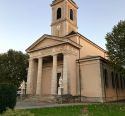

Romanesque church Saint Julian
Rue de l'Eglise Saint-Julien
71240 Sennecey-le-Grand
Church | XI-XII | Romanesque | Catholic Church
Map
Opening hours
01 June - 20 September
Mon 10.00 - 19.00
Tue 10.00 - 19.00
Wed 10.00 - 19.00
Thu 10.00 - 19.00
Fri 10.00 - 19.00
Sat 10.00 - 19.00
Sun 10.00 - 19.00
01/10 - 31/05 : open on request
Description
It was spared during the French Revolution, and escaped being closed down when the parish church was built in the mid 1830’s, the restorations which usually washed off all the wall paintings to reveal the stone work, and finally destruction as it was along the first plan for the A6 motorway in the mid 1960’s.
Practically abandoned from the middle of the 19th century, it was used for silk-worm production, a hay-loft, and even a hiding-place during the last war.


Photos


Remarkable elements

15th century choir painting
Gradually, this listed monument freed itself from its yokes thanks to the presence of paintings in one of its chapels, and the town council looked for ways to undertake its restoration while respecting the church's historic past. It was during this restoration, under the aegis of Bâtiments de France and the town council, that all the 15th century paintings in the choir were discovered and brought to light. They were found to be complete and authentic.

Transept decoration
The transept preserves the oldest decorations in the church. Crescent moons, stars and false joints date from the late 13th century. The traces of altars and statues are a reminder of intense devotion. In the south arm, three layers of superimposed murals illustrate the evolution of the decoration: a 13th-century scene, the Martyrdom of Saint Sebastian in the 15th century, then an Adoration of the Magi at the end of the 16th or beginning of the 17th century, each associated with an altar.

Seigniorial chapel of the Lugny family
Founded at the end of the 15th century by Claude de Lugny, this chapel is distinguished by its remarkable painted decoration, which was listed in the 19th century. The blue vault with gold stars rests on corbels depicting angels holding coats of arms. The sculpted keystones and plant motifs frame a 16th-century painted cycle depicting the major episodes in the life of the Virgin Mary.

West portal
The west doorway, concealed by a 17th-century porch, has a semi-circular opening lined on the outside with an ornate archivolt, which rests on abacuses supported by columns with capitals and decorated bases. A large 15th-century window opens above this doorway.

Chapel of Vellaufant
Located to the left of the chevet, this 14th-century chapel is the oldest in the church. Dedicated to the Virgin Mary, it contains a 17th-century mural depicting the Visitation. The restored 18th-century altar tomb has housed the lords of Sennecey since 1824. The diamond-shaped stained-glass windows and the grille of the hagioscope have been restored in keeping with the original design.
Partners