Our Lady
Brugsesteenweg
8433 Mannekensvere (Middelkerke)
Church | 1924-1925 | Neogothic | Catholic Church


Map
Opening hours
01 May - 30 September
Mon 10.00 - 16.00
Tue 10.00 - 16.00
Wed 10.00 - 16.00
Thu 10.00 - 16.00
Fri 10.00 - 16.00
Sat 10.00 - 16.00
Sun 10.00 - 16.00
Religious offices
Description
The robust Church of Our Lady of Mannekensvere in typical yellow brick of polder clay is surrounded by a cemetery.
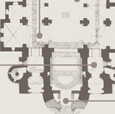
It is a three nave neogothic cental hall church thanks to a design from 1922, with an older tower from 1860. The building replaces a medieval church that was destroyed during the First World War, when almost the whole village was vanished. During the Second World War the village suffered also and was put completely under water.
Thanks to the order of the Knights Templars, who had a lot of properties and rights in this region, already early a chapel was built in Mannekensvere, that was transformed into this church of full value. The order of Knights Templars was a religious order of knighthood that during the crusade made the Holy War upon the Muslims in the Holy Land.
The west tower has a pavilion-roof. Outside the church, at the north side, you can see an image of Christ beneath a porch. The interior is white-washed underneath a sharp arched roof in wood. The sober furniture is made by the art technical school of Maredsous in 1925. The altars are made in a lightly art-deco style.
Mannekensvere itself arised, probably in the first half of the 12th century, along the road of communication Nieuport-Bruges. It was so named thanks to the proximity of the Yser where there was the shipping traffic from Ieper to Nieuport. Upon payment people could use the ferry-boat across the Yser. Mannekin was probably his earl’s captain of the ferry.
KIKIRPA : Photo-library online
Cycle route 'Geloof en Bijgeloof'
Photos


Remarkable elements

Font
After being damaged, the old basin was placed on a new base.
Harmonium
The harmonium bears the name and address of Jacob Alexandre, one of three top harmonium builders in France. Between 1829 and 1851 the firm’s work place was Boulevard de Bonne Nouvelle, proof that the instrument dates from that period.
High altar
The church furniture was created in 1925 by the Arts and Crafts School of the Benedictine Abbey of Maredsous. Its aim was to develop a new religious art marked by simplicity and clean lines. The former high altar, made of Belgian pink marble, consists of an altar tomb, candle ledge and tabernacle. A mosaic on the front displays the Chi-Rho (XP), symbol of Christ. The tabernacle doors, decorated with two angels, are crafted from hammered copper.

Altar and lectern
The new altar and lectern were made from parts of the former communion rail and pulpit. Eucharistic symbols, including the five loaves, two fish, pelican and source of grace, decorate the altar. The lectern depicts Elijah, Christ healing a paralysed man and Moses. This remarkable ensemble was brought together by Pastor Achiel Baert after World War I.

Old tombstone
Next to the altar of Saint Hubert stands an old tombstone against the wall. It originates from a former rectory. Many have heard of the sermons of the “pastor of Mannekensvere” who swore the oath of allegiance to the French regime and who delivered his sermons in twisted words and sentences. Humor was a powerful weapon against the occupying forces.