

Saint Lawrence
Place du Général Pershing
55270 Montfaucon d'Argonne
Church | 1931 | Neoromanesque | Catholic Church


Map
Opening hours
01 April - 30 September
Mon 10.00 - 18.00
Tue 10.00 - 18.00
Wed 10.00 - 18.00
Thu 10.00 - 18.00
Fri 10.00 - 18.00
Sat 10.00 - 18.00
Sun 10.00 - 18.00
01 October - 31 March
Mon
Tue
Wed
Thu
Fri
Sat 10.00 - 18.00
Sun 10.00 - 18.00
Description
According to tradition, Saint Baldéric, a Frankish prince from the Rhine region, seeking solitude, chose to establish a hermitage on this hill after a falcon had shown him the spot. Around 620, he founded the region’s first monastery there, dedicated to Saint Peter and governed by the Rule of Saint Benedict, where the future Saint Waudrille would later stay.
Over the centuries, Montfaucon experienced periods of prosperity and destruction. Abandoned under Charles Martel, the monastery was revived under Charlemagne who, according to tradition, transformed the abbey church into a collegiate church dedicated to Saint Germain following the arrival of the saint’s relics. In 888, the site was the scene of a decisive victory by Eudes over the Normans.
Although spared by the Revolution, the collegiate church nevertheless saw its canons go into exile, whilst the parish church of Saint-Laurent disappeared after having already suffered during the Thirty Years’ War. Rebuilt in the 19th century in the Neo-Romanesque style and adorned with stained-glass windows by Charles Lorin, it was destroyed once again during the First World War. Owing to its strategic position, the hill was home to a German observation post and was recaptured by American troops in September 1918.
Rebuilt at the foot of the hill, the village has been given a new lease of life. As early as 1929, Saint-Laurent Church was rebuilt to match its previous structure exactly. Today, the remains of the collegiate church, the blockhouses and the surrounding landscape bear witness to this exceptional past.
Translated with DeepL.com (free version)

Photos


Remarkable elements
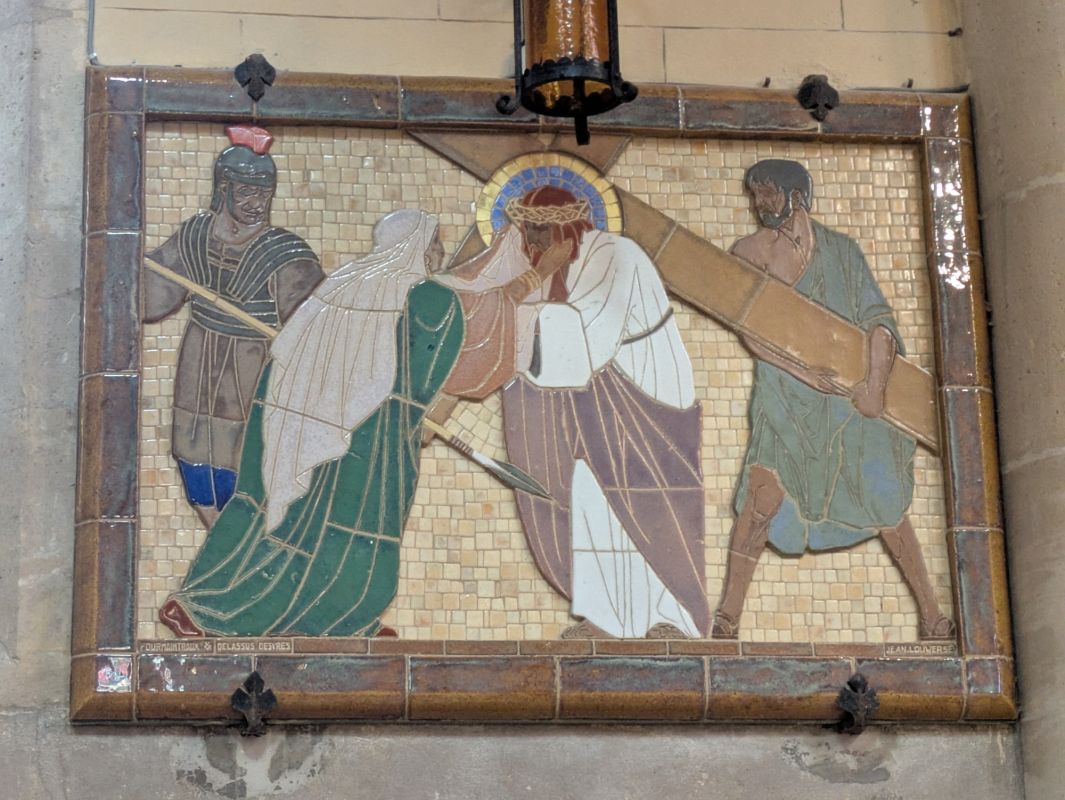
Way of the Cross
The fourteen stations of the Way of the Cross, crafted from Desvres (Pas-de-Calais) ceramic, were produced by the Fourmaintraux-Delassus workshops. Created in the Art Deco style during the interwar period, these remarkable bas-reliefs are the work of Jean Louwerse. Rare in France, they are replicas of the Way of the Cross in the Church of Saint-Sauveur in Desvres and of the one created for Chicago Cathedral.
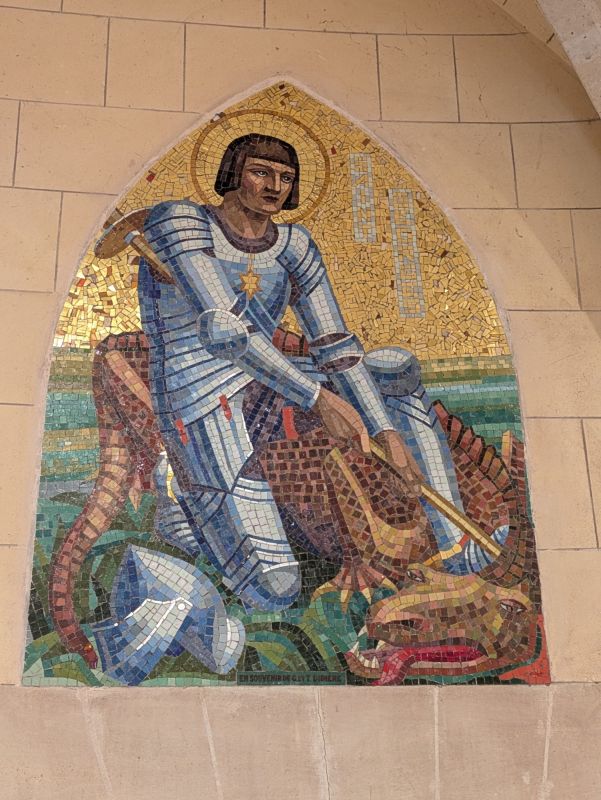
Mosaics
These mosaics, typical of the Art Deco style with their geometric shapes, are by M. Dano, Charles Lorin and Co. The first depicts Saint Christopher carrying the Infant Jesus, a symbol of protection for travellers. The second depicts Saint George slaying the dragon, an emblematic figure representing the triumph of good over evil.
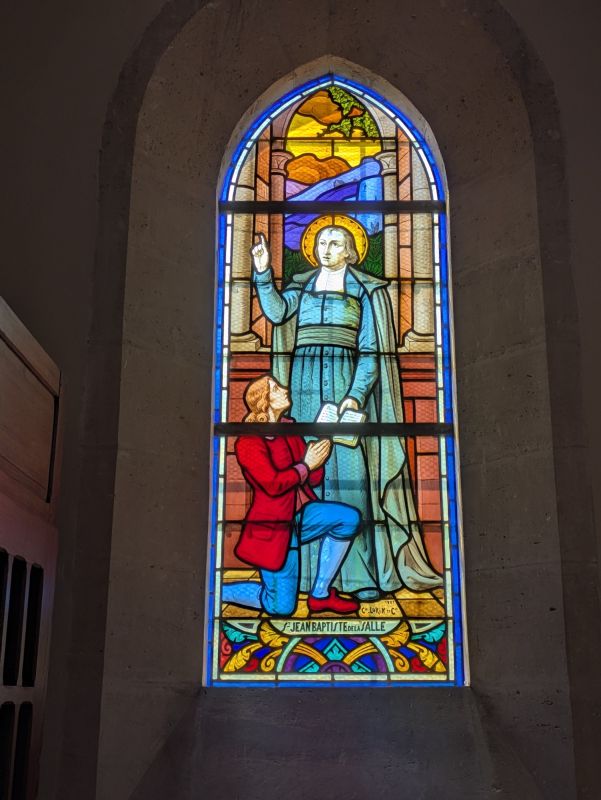
Stained-glass windows
Created in 1931 by the Charles Lorin Workshops in Chartres and Paris, these stained-glass windows are in the Art Deco style. Five windows in the chancel depict the Battle of Montfaucon (888), inspired by designs probably preserved from the former Saint-Germain collegiate church, and subsequently reinterpreted in the style of the time. The other stained-glass windows depict religious scenes as well as saints who were particularly venerated in the early 20th century.
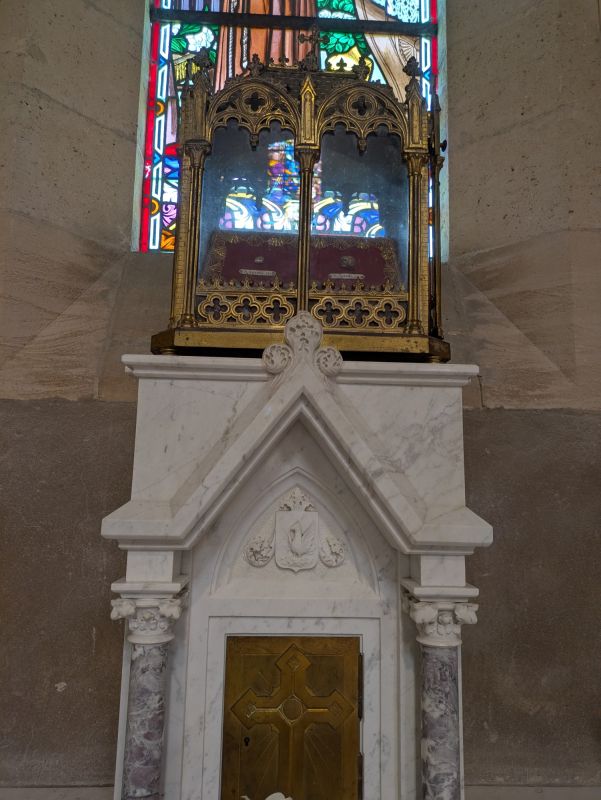
Reliquary of Saint Baldéric
This 19th-century Neo-Gothic reliquary once housed the relics of Saint Baldéric, which were stolen in 1989. Having died in Reims, the saint was first buried at Saint-Pierre-lès-Dame before his remains were transferred to the parish church. Over the course of invasions and wars, his relics were moved and scattered. In 1780, they were solemnly transferred to the church. A copper reliquary made in 1885 disappeared during the Great War before reappearing in Stenay.
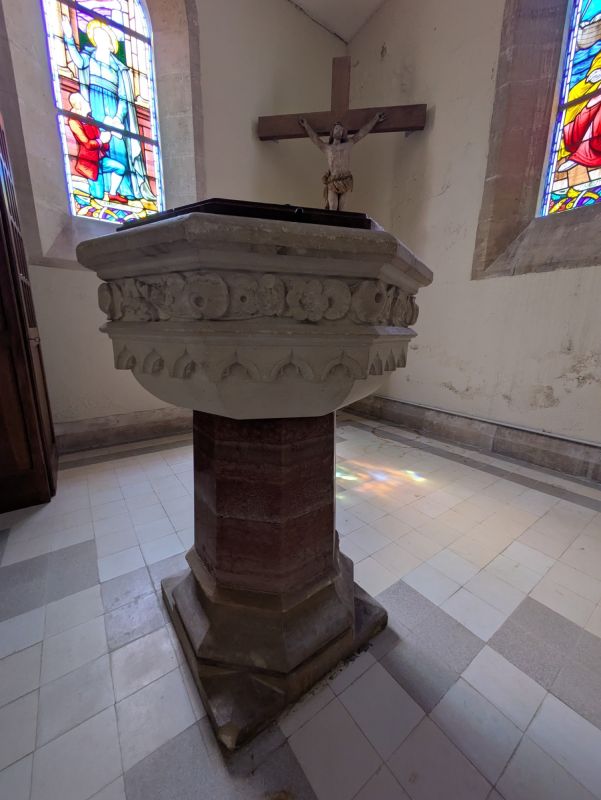
Baptismal font
Situated in the baptistery chapel, this two-tone baptismal font consists of a column and an octagonal sandstone basin. The basin is adorned with friezes featuring architectural and floral motifs, reflecting the care taken with this essential element of Christian life.
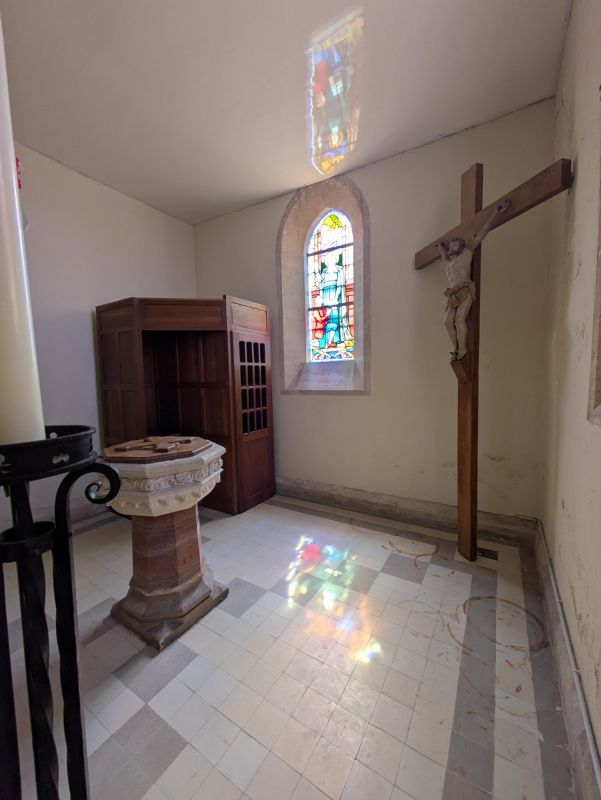
Christ on the Cross
A carved and polychrome wooden Christ on the Cross, attributed to the 18th century. His understated anatomy, bowed head and serene facial expression convey a measured suffering, characteristic of that period. The perizonium, with its simple, undulating folds, is also typical of 18th-century works. The cross, however, is of a more recent period.
