
Our Lady
rue de l'église
62690 Capelle-Fermont
Church | XIe-XIVe | Romanesque | Catholic Church

Map
Opening hours
06 June -
Mon
Tue
Wed
Thu
Fri
Sat 11.30 - 14.00
Sun
19 September - 20 September
Mon
Tue
Wed
Thu
Fri
Sat 10.00 - 17.00
Sun 10.00 - 17.00
12 December - 13 December
Mon
Tue
Wed
Thu
Fri
Sat 10.00 - 17.00
Sun 10.00 - 17.00
Description
The village’s name is closely linked to its religious history. Derived from the Picard language, the place name ‘Capella’, meaning ‘chapel’, suggests that the first group of dwellings was clustered around a place of worship. Several sources indicate that this site was dedicated to the Virgin Mary at a very early stage.
First recorded in the 13th century, the village, which fell under the bailiwick of Aubigny-en-Artois, gradually expanded over the centuries and, by the 18th century, had incorporated the hamlet of Fermont.
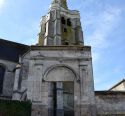
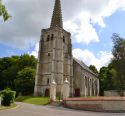
The Church of Notre-Dame de Capelle-Fermont was built in the 11th century and still bears characteristic features of Romanesque architecture, recognisable by its semicircular arches.
In the 16th century, it was rebuilt and remodelled to incorporate defensive elements. The nave was then raised to fortify the building, whilst a refuge chamber was fitted out above it to shelter the population in times of unrest.
But what makes the church truly unique are its two bell towers, known in Picard as ‘campenards’. One can be glimpsed at the level of the choir’s triumphal arch, whilst the second, dating from the 13th century, adorns the western façade.
The interior of the church surprises with its brick vaults and invites visitors to discover furnishings dating from the 18th century, as well as to seek out traces of its ancient architecture.
Translated with DeepL.com (free version)

Photos




Remarkable elements

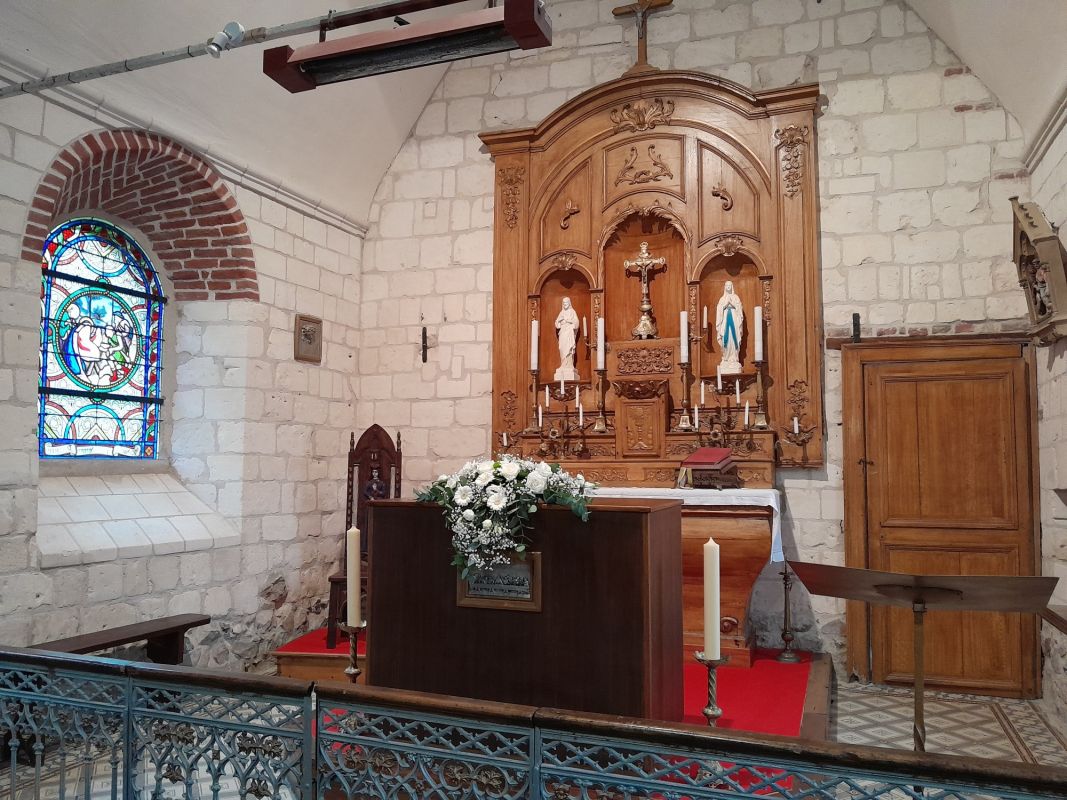
High Altar
A wooden high altar dating from the late 18th or early 19th century, in the Rococo style, dedicated to the Virgin Mary.

Confessional
A wooden confessional dating from the late 18th or early 19th century, with a simple design, surmounted by a pediment featuring a carved angel’s head.

Tabernacle
A carved and painted wooden tabernacle, framed by two winged cherubs and surmounted by a medallion depicting the Sacred Heart of Jesus. The door of the tabernacle is richly adorned with a radiant monstrance, flanked at its base by ears of wheat and bunches of grapes, recalling the function of this liturgical piece: to preserve the consecrated hosts for the Eucharist.
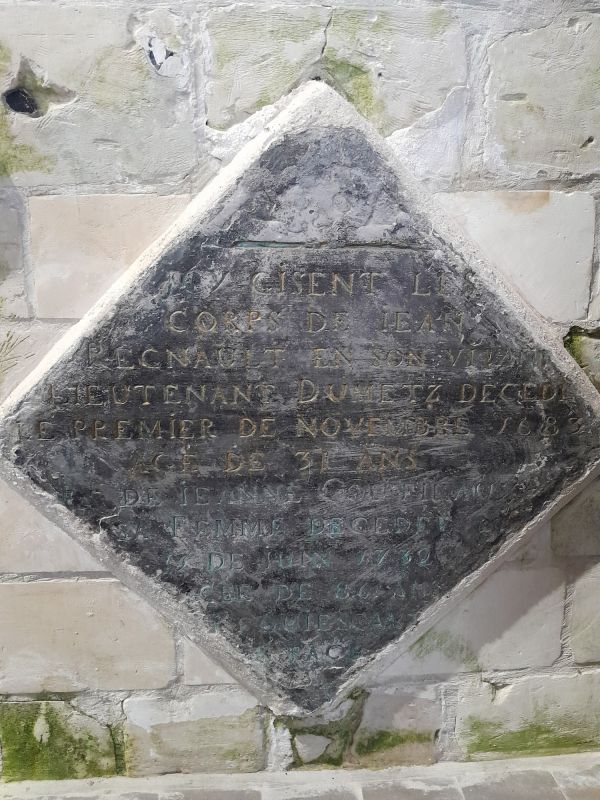
Tombstone of Jean Regnault and his wife
Set into the wall, this 18th-century tombstone, carved from Tournai stone, bears an epitaph dedicated to Jean Regnault, lieutenant of Metz (in the territory of Capelle), who died on 1 November 1683 at the age of 31, and to his wife, who died on 15 June 1732 at the age of 86.

Virgin and Child
Virgin and Child in gilded wood.

Stained-glass windows
The narrative stained-glass windows in the chancel date from the late 19th century, between 1895 and 1898. They depict, from left to right: a Pietà, the Adoration of the Shepherds, the Last Supper and the apparition of the Sacred Heart to Saint Thérèse.
In the nave, grisaille paintings were added in the 19th century.