
Our Lady of the Assumption
Voormezeledorp
8902 Voormezele (Ieper)
Church | 1923 | Neoromanesque | Catholic Church
Map
Opening hours
01 January - 31 December
Mon 12.00 - 17.00
Tue 12.00 - 17.00
Wed 12.00 - 17.00
Thu 12.00 - 17.00
Fri 12.00 - 17.00
Sat 12.00 - 17.00
Sun 12.00 - 17.00
Religious offices
Description
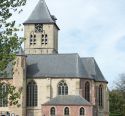
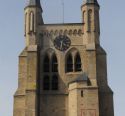
This church has a rich history dating back to 1068, when it was founded as an abbey church. Like many religious buildings, it was destroyed after the French Revolution and later rebuilt several times. Between 1807 and 1811, it was reconstructed in Neoclassical style with three aisles and an integrated west tower. The First World War caused further destruction, and the present church was built in 1923 to the plans of architect Jules Coomans.
The church remains surrounded by its historic cemetery, where the impressive tomb of the de Geus family can still be seen, along with several old gravestones incorporated into the walls of the side aisles.
Architecturally, the building combines Neo-Romanesque features with regional and Neo-Byzantine influences. It was constructed in the characteristic yellow polder stone, while bluestone was used for decorative details. The Neo-Romanesque interior preserves memories of the former Augustinian Abbey of Our Lady of Voormezele, including a painting depicting the abbey in 1619, a commemorative plaque listing its provosts and abbots, and several stone objects originating from the monastery, such as a holy-water font and a heraldic cartouche.
Each year, on the first Sunday after Pentecost, the Holy Blood Procession takes place. It honours the relic of the Holy Blood preserved in the church, believed to have been brought back from Rome by Knight Isaac in 1152. In 1952, the 800th anniversary of the relic gave rise to the modern form of the procession. Today, around 650 participants take part in this colourful event, recreating the historical tradition through music, acting and ceremonial performances.
Photos


Remarkable elements

Relic of Holy Blood
The precious relic would have been taken by knight Isaac in 1152 during one of his trips to Rome. 1952 was the jubilee year for 800 years of Holy Blood in Voormezele. On that occasion the jubilee procession that goes out on the Sunday after Pentecost took its present form. In the procession there are about 650 participants and there is an evocation of the historical event with song, play and movement.
Translated with www.DeepL.com/Translator

Christ on the cold stone
Statue donated by village priest Rev. Jozef Verstraete.

Scale models of the evolution of the old abbey
A number of models show the infrastructural evolution of the old abbey from its origins to its destruction during the French Revolution.

Marble holy-water font
The holy water font in the portal of the church is a remnant of the old abbey under French regime in 1794.
Overview priest services
Copper plate with an overview of all priests who served at the parish from 1469 until today.
List of the deans and abbots of the abbey
Copper plate with an overview of all the deans and abbots of the abbey from 1100 to 1782-1796.