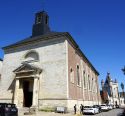

Saint Fermin
Paul Cathelain
80550 Le Crotoy
Church | XVIe | Neogothic | Catholic Church


Map
Opening hours
01 May - 31 October
Mon 9.00 - 19.00
Tue 9.00 - 19.00
Wed 9.00 - 19.00
Thu 9.00 - 19.00
Fri 9.00 - 19.00
Sat 9.00 - 19.00
Sun 9.00 - 19.00
01 November - 30 November
Mon 10.00 - 17.00
Tue 10.00 - 17.00
Wed 10.00 - 17.00
Thu 10.00 - 17.00
Fri 10.00 - 17.00
Sat 10.00 - 17.00
Sun 10.00 - 17.00
Description
Nestled in a hamlet of the charming seaside town of Le Crotoy, on the edge of the Marquenterre Nature Reserve, lies the Church of Saint-Firmin.
A fire in 1901 devastated the church, which was subsequently rebuilt: the roof of the nave was raised to bring it into line with that of the chancel, and the nave was rebuilt in brick in the Neo-Gothic style.
In the heart of the Baie de Somme nature reserve, between the coastal river Maye and the ‘foraines’ of Saint-Firmin, the village of Berteaucourt – which would later take the name Saint-Firmin-lès-Crotoy – became a holiday resort very early on. As early as the 5th century, Regnacaire, a Frankish chieftain close to Clovis, is said to have owned a country house on these lands, which were subsequently established as a seigneury.
Saint-Firmin Church is first recorded in the 12th century. A watercolour painted in 1850 by Oswald Macqueron, held at the Abbeville library, depicts the building with its nave lower than the chancel. The whole structure is built of sandstone, notably the porch tower and its 16th-century bulbous bell tower, which houses a 900 kg bronze bell dating from 1519, listed as a Historic Monument. The chancel and the tower are the oldest parts of the present building.
Today, the Association for the Preservation of the Two Churches, in partnership with the local council, works to preserve and showcase this rich religious heritage. Through a variety of events, tours, activities and concerts, it helps to bring this historic site to life and enable people to discover it.
Translated with DeepL.com (free version)

Photos


Remarkable elements

Saint Firmin
Saint Firmin of Amiens, the city’s first bishop in the 3rd century, was a missionary from Spain. He is said to have preached in northern Gaul before being arrested during the Roman persecutions. Refusing to renounce his faith, he was martyred around 303. His cult grew rapidly in Picardy, where he became one of the principal patron saints.

Stained-glass windows
Dating mainly from 1870, the stained-glass windows in the chancel depict Saint Firmin, the Virgin Mary and Saint John the Baptist. Others, dating from 1903, were produced by the Vermonet workshop in Reims and depict Marian figures (north) and various saints such as Saint Hubert and Saint Anthony (south).
Translated with www.DeepL.com/Translator (free version)

Architecture of the choir
The choir features remarkable keystones in bas-relief. The four Evangelists and their symbols are depicted there (the ox, the man, the eagle and the lion), as well as the instruments of Christ’s Passion. A radiant sun with a human face accompanies these decorations, a medieval motif associated with the Resurrection of Christ.
Also depicted are Saint Anthony and his pig, as well as angels holding scrolls or trumpets.
Translated with www.DeepL.com/Translator (free version)
Neo-Gothic furnishings
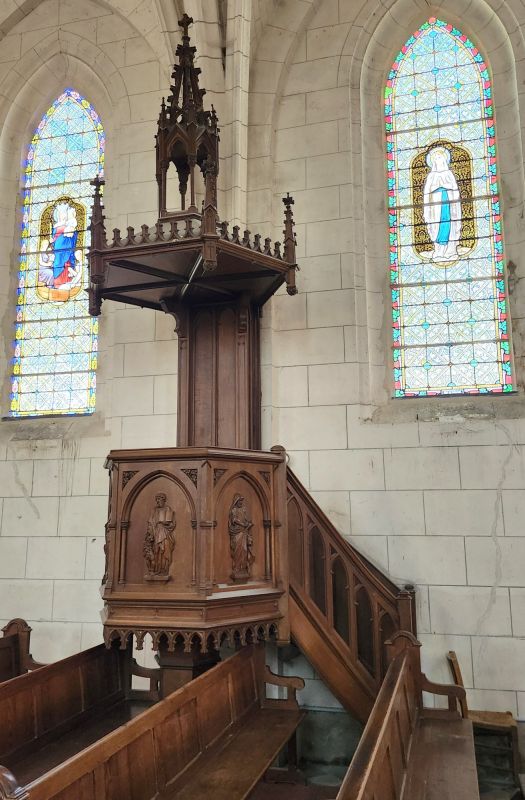
The church’s furnishings comprise a stone baptismal font, a carved pulpit depicting the Evangelists with their attributes, communion benches, a high altar depicting the Twelve Apostles, and side altars dedicated to the Virgin Mary and Saint Firmin.
The ornamentation featuring pinnacles, so characteristic of this style, emphasises its distinctive vertical aesthetic.
Translated with www.DeepL.com/Translator (free version)

Funeral slabs
Eighteenth-century gravestones have been preserved, such as those of Louis France and his wife Marie Anne Boitel. Burial inside the church was a privilege reserved for clergy and certain lords, founders or benefactors. However, lay people could be admitted in return for a life of devotion and a bequest. Plots near the altar or the chapels were the most sought-after.
Translated with www.DeepL.com/Translator (free version)
Statue of Saint Eloi
At the entrance to the nave stands a plaster statue of Saint Eloi as a bishop, recognisable by his anvil. Dating from the 19th century, it is now listed as a Historic Monument.