
Saint Peter
Rue de Gerbeuville
55300 Spada
Church | 1924 | | Catholic Church


Map
Opening hours
01 April - 30 September
Mon 10.00 - 18.00
Tue 10.00 - 18.00
Wed 10.00 - 18.00
Thu 10.00 - 18.00
Fri 10.00 - 18.00
Sat 10.00 - 18.00
Sun 10.00 - 18.00
01 October - 31 March
Mon 10.00 - 17.00
Tue 10.00 - 17.00
Wed 10.00 - 17.00
Thu 10.00 - 17.00
Fri 10.00 - 17.00
Sat 10.00 - 17.00
Sun 10.00 - 17.00
Guided tour
+33 3 29 89 06 47
Religious offices
Sunday : 9.30 am / 10.30 am
Description
Part of the Barrois region, which had remained undivided since the Treaty of Bruges in 1301, the Duchy of Bar-le-Duc was for a long time under the authority of the Holy Roman Empire. The Treaty of Vienna in 1738 granted Lorraine and the Barrois region to Stanisław Leszczyński, the former King of Poland and father-in-law of Louis XV, for life. On his death in 1766, the territory was definitively annexed to the Kingdom of France.
Several centuries later, Spada found itself at the heart of the fighting during the First World War. With the front line running through it, the village and its church were completely destroyed, as were the archives, leaving only a postcard bearing witness to the damage and ruins. Awarded the Croix de Guerre, the town began its reconstruction with the architects from Saint-Mihiel, François Tréchot and Charles Langlois. Their design, approved in 1924, was built on the foundations of the original church.
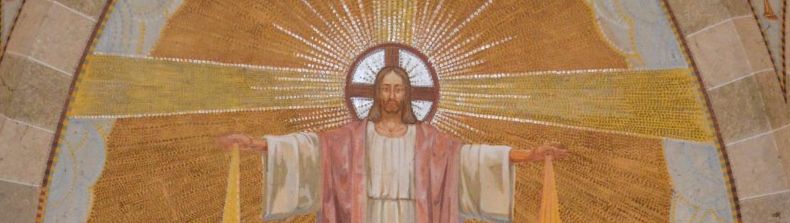
Saint-Pierre Church features a single nave extended by a choir with a flat chevet. Above all, it preserves an exceptional work by the Italian-born artist Duilio Donzelli: a monumental fresco begun in 1938–1939 but left unfinished, probably due to budgetary constraints. The pencil sketches still visible bear witness to the ‘abrupt’ interruption of this vast project. The furnishings themselves appear to have remained unfinished, as evidenced by the mandorlas fitted above the side altars, intended to house statues surrounded by angels.
Translated with DeepL.com (free version)
Photos


Remarkable elements

Neo-Gothic façade
The church in Spada features a remarkable Neo-Gothic façade characterised by its three bays topped with pointed arches. The pediment above the entrance features a carved rose motif, a design inspired by the roses found on Gothic façades.
Translated with www.DeepL.com/Translator (free version)

Choir fresco
The choir, which is entirely painted, depicts a scene from the Last Judgement. Christ, standing and radiant, sends his light towards the elect with his right hand and strikes down the damned, who are burning, with his left hand. In front of him stand Saint Peter (holding a key) and Saint Paul (holding a sword). Above, on either side of the mural, angels herald the Last Judgement with their trumpets.
Translated with www.DeepL.com/Translator (free version)

Chapel of the Dead
At the back of the church, a chapel entirely covered in paintings commemorates the victims of war. It houses the war memorial. The walls are adorned with painted friezes featuring alternating crosses and Adrian helmets surrounded by laurel wreaths. A magnificent patriotic stained-glass window illuminates this place of contemplation.
Translated with www.DeepL.com/Translator (free version)

Our Lady of Mercy
This statue, probably dating from 1520, is attributed to the sculptor Jean Crocq, a precursor of Richier Ligier.
The statue has retained its polychrome paintwork and features a distinctive detail: the Virgin is holding a veil in her hand to wipe Christ’s face. Only two other churches in the area house a statue of the Virgin depicting this gesture: the church at Vassincourt and the church at Louppy-sur-Loison.
Translated with www.DeepL.com/Translator (free version)

Choir furnishings
A few years after Vatican II, the high altar was moved to a position near the baptismal font. A new altar was installed in the chancel: a stone slab, owned by the local council, was brought into the church and cut in two. Formerly used by farmers to compact the soil, this makeshift altar bears witness to the ingenuity and commitment of the local community and continues to occupy a place of honour in the church.
Translated with www.DeepL.com/Translator (free version)

Scale model
In the early 1950s, a gathering of the Saint-Mihiel deanery invited each parish to bring a scale model of its church. Some were made of cardboard or wood and are instantly recognisable. This is a memory that still lives on among the older generation, who sometimes even recall the name of the person (or family) who made the model of their church!
Translated with www.DeepL.com/Translator (free version)
Nearby


Circuit
Treasures of the Sammiellois

Around Saint-Mihiel, bell towers regularly stand out in the hills. Push open the doors of these churches to discover the treasures of the Sammiellois. Donzelli, Ligier Richier and others await you...